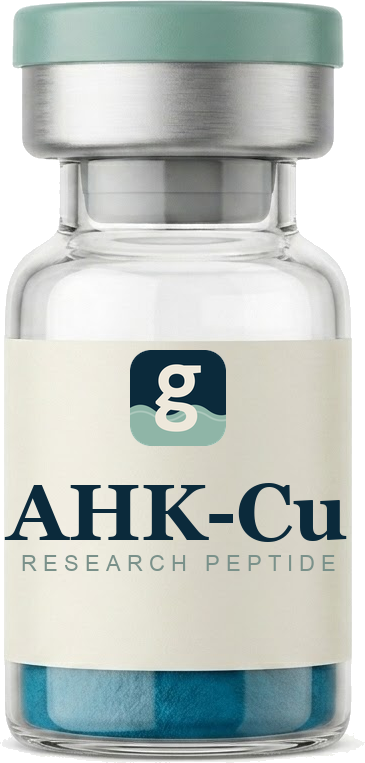
AHK-Cu
AHK-Cu is a copper-bound tripeptide (alanine-histidine-lysine) closely related to GHK-Cu, differing by a single amino acid. It is used topically as a scalp and skin serum to support hair-follicle growth, collagen synthesis and dermal repair, and is applied to the skin rather than injected.
Best for
People exploring topical support for thinning hair, scalp health or skin firmness who want a copper-peptide alternative to GHK-Cu.
What to expect
Hair and scalp changes are slow: early signs typically appear at 2-3 months, with more meaningful improvement at 4-6 months of consistent daily use.
Pairs with
Often paired topically with GHK-Cu, minoxidil, or standard scalp-care routines; can also be run standalone.
Used topically, not injected: research and commercial serums run roughly a 1-5% (100-500 ppm) copper tripeptide-3 solution, delivering on the order of 0.5-1 mg of peptide per application, massaged into the scalp or skin once daily (evening) after cleansing. Conservative starting point is the lower 0.5 mg / ~1% end, since higher concentrations were counterproductive in vitro.
- How often
- Daily
- When
- Bedtime
- Route
- Topical
- Cycle
- Typically used continuously over 4-6 months, as hair and scalp changes emerge slowly and reverse if discontinued.
The same numbers the goodtides app and the Dose Calc use — a research reference, not a prescription. Responses are individual; research protocols start at the low end.
AHK-Cu is a synthetic copper-binding tripeptide with the sequence alanine-histidine-lysine complexed to a copper(II) ion, a close structural relative of the naturally occurring GHK-Cu copper peptide, from which it differs only by substituting alanine for glycine at the first position.
AHK-Cu is not FDA-approved, is sold for research and cosmetic-ingredient use only, is not a treatment for any medical condition, and should be used only with appropriate physician guidance.
Like other copper peptides, it acts as a copper carrier and as a signaling molecule that modulates fibroblast and dermal papilla cell activity. In vitro work has shown it can stimulate elongation of isolated human hair follicles and proliferation of dermal papilla cells at very low picomolar-to-nanomolar concentrations, an effect attributed partly to reduced apoptosis (a favorable Bcl-2/Bax shift) in those cells.
Copper additionally serves as an enzymatic cofactor in collagen and extracellular-matrix formation, and cultured fibroblast studies report substantial increases in type I collagen synthesis. Proposed supporting pathways include VEGF-driven angiogenesis and modulation of TGF-beta1 signaling associated with follicle miniaturization.
A notable and honest caveat is that the dose-response is biphasic: growth was stimulated at low concentrations but inhibited at higher ones, so more is not better. The human evidence base is limited and largely in vitro or preclinical.
References3
- Pyo HK et al. - The effect of tripeptide-copper complex on human hair growth (Arch Pharm Res) (in vitro, human hair follicles)
- Pickart L, Vasquez-Soltero JM, Margolina A - GHK peptide as a natural modulator of multiple cellular pathways in skin regeneration (Biomed Res Int) (review of in vitro and animal work)
- Gorouhi F, Maibach HI - Role of topical peptides in preventing or treating aged skin (Int J Cosmet Sci)
Log every dose, count every vial, and verify your batches — free in the goodtides app.
This page is educational reference material about compounds studied in research settings. It is not medical advice, and nothing here is a recommendation to buy, possess, or use any compound. Research findings described are from published literature; individual compounds may not be approved for human use. Talk to a licensed clinician about anything that affects your health.