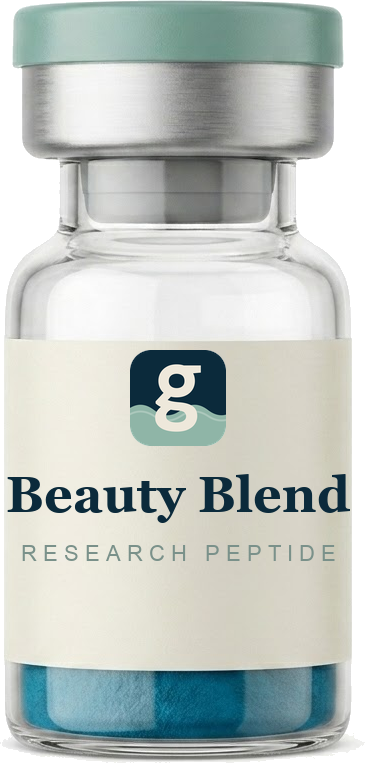
Beauty Blend
Beauty Blend is a single premixed vial pairing GHK-Cu (50 mg) with KPV (10 mg) for 60 mg total in 3 mL, studied in research contexts for skin, hair, collagen, and anti-inflammatory support; research protocols dose by insulin units, starting around 10 units and building toward 30 units (about 5 mg GHK-Cu plus 1 mg KPV per day) subcutaneously.
Best for
It combines GHK-Cu's research on wound healing, skin regeneration, collagen and elastin synthesis, hair-follicle support, and antioxidant/anti-inflammatory activity with KPV's research on gut and systemic inflammation, making it a skin- and appearance-focused blend with an anti-inflammatory component.
What to expect
Research on the individual components describes gradual changes rather than acute effects: skin- and collagen-related GHK-Cu effects are typically characterized over several weeks of repeated exposure, and KPV's anti-inflammatory effects in preclinical models emerge over days of repeated administration. No validated human time-to-effect for the blend is established.
Pairs with
Within this product GHK-Cu and KPV are already combined; in broader research practice both are grouped with recovery- and regeneration-oriented peptides such as BPC-157 and TB-500 (as in the GLOW and KLOW blends) rather than added to further stimulatory agents.
Premixed GHK-Cu + KPV blend (60 mg / 3 mL = 20 mg/mL), dosed by VOLUME.
The ladder is read in mg per component: 10 units on a U-100 syringe for maintenance (about 1.7 mg GHK-Cu and 0.33 mg KPV), 20 units for recovery (3.3 / 0.67 mg) and 30 units for healing (5 mg GHK-Cu and 1 mg KPV — the daily research ceiling of both), subcutaneously. GHK-Cu can sting — let the filled syringe reach room temperature (~20 min) before injecting.
- How often
- Daily
- Route
- Subcutaneous
- Vial & water
- 60 mg in 3 mL · 10 units ≈ 1.67 mg GHK-Cu + 0.33 mg KPV
- Cycle
- Often run in 10-20 day courses with a break, or continuously for skin/hair support - your call. Copper stings, so build the dose up slowly.
The same numbers the goodtides app and the Dose Calc use — a research reference, not a prescription. Responses are individual; research protocols start at the low end.
Beauty Blend is a single premixed vial combining two research-grade peptides - GHK-Cu (50 mg) and KPV (10 mg), for 60 mg total in 3 mL - built to cover skin, hair, and anti-inflammatory pathways at once.
GHK-Cu is a copper(II)-binding tripeptide with the amino acid sequence glycyl-L-histidyl-L-lysine, occurring naturally in human plasma, saliva, and urine; circulating levels have been reported to decline with age (roughly 200 ng/mL at age 20 to about 80 ng/mL by age 60). Rather than acting on a single classical receptor, research characterizes it as a signaling and copper-carrier peptide that modulates the extracellular matrix: studies report it stimulates synthesis of collagen, elastin, glycosaminoglycans, and proteoglycans such as decorin, while modulating matrix metalloproteinases and their inhibitors during tissue remodeling, alongside antioxidant and anti-inflammatory gene-level effects and research interest in hair-follicle health.
KPV is a synthetic tripeptide (Lys-Pro-Val) corresponding to the C-terminal sequence (residues 11-13) of alpha-melanocyte-stimulating hormone (alpha-MSH); research characterizes it as retaining much of alpha-MSH's anti-inflammatory signaling while lacking the pigment-stimulating activity of the full hormone, with studies reporting inhibition of the NF-kappaB and MAP-kinase inflammatory pathways and reduced pro-inflammatory cytokines such as TNF-alpha and IL-6. Neither peptide is FDA-approved for human use, so this is strictly a research-context blend; the copper in GHK-Cu can sting at the injection site, so let the filled syringe reach room temperature (about 20 minutes) and inject slowly.
Each batch is independently lab-tested for identity and purity across both components per our standard COA process.
References4
- Pickart L, Margolina A - Regenerative and Protective Actions of the GHK-Cu Peptide, Int J Mol Sci
- Pyo HK et al. - The effect of tripeptide-copper complex on human hair growth in vitro, Arch Pharm Res (PubMed 17703734)
- Dalmasso G et al. PepT1-mediated tripeptide KPV uptake reduces intestinal inflammation (mouse model)
- Kannengiesser K et al. Melanocortin-derived tripeptide KPV has anti-inflammatory potential in murine models of inflammatory bowel disease (murine model)
Log every dose, count every vial, and verify your batches — free in the goodtides app.
This page is educational reference material about compounds studied in research settings. It is not medical advice, and nothing here is a recommendation to buy, possess, or use any compound. Research findings described are from published literature; individual compounds may not be approved for human use. Talk to a licensed clinician about anything that affects your health.