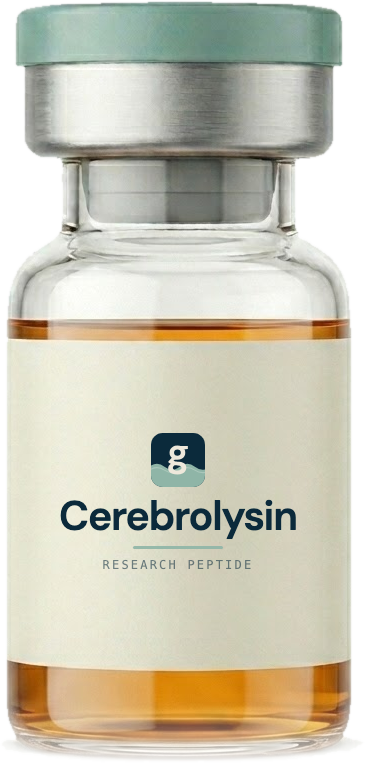
Cerebrolysin
Cerebrolysin is a neurotrophic peptide preparation derived from purified porcine brain tissue (free amino acids plus low-molecular-weight neuropeptides) studied for cognitive and neurological recovery; research protocols typically give 1 mL daily intramuscularly over courses of about 10-21 days.
Best for
It has been studied primarily in cognitive and neurological recovery research, including ischemic stroke, vascular dementia, Alzheimer-type dementia and traumatic brain injury, with mixed and still-debated results.
What to expect
Research using daily courses has reported functional changes emerging over the multi-week treatment period and in some trials continuing during post-treatment follow-up, rather than acutely after a single dose.
Pairs with
In studies it has been examined alongside standard-of-care therapies such as thrombolysis (tPA) and cholinesterase inhibitors, and is sometimes discussed in research contexts with other neuroprotective agents like citicoline.
Cerebrolysin comes premixed as a ready-to-use solution, so it is never reconstituted and no BAC water is added. The dose is drawn in mL straight from the ampoule and given as an intramuscular injection.
In clinical research it has typically been given as a daily intravenous infusion or intramuscular injection (commonly in the 5-30 mL/day range) over courses of roughly 10-21 consecutive days rather than continuously.
- How often
- Daily
- When
- Morning
- Route
- Intramuscular
- Premixed
- Ready-to-use liquid, nothing to mix and no BAC water. Draw 1 mL straight from the ampoule, one ampoule per dose.
- Cycle
- 10–20 day cycles, several per year
The same numbers the goodtides app uses — a research reference, not a prescription. Responses are individual; research protocols start at the low end.
Cerebrolysin is not a single peptide but a standardized, enzymatically processed mixture derived from purified pig (porcine) brain tissue, composed of roughly 75% free amino acids and 25% low-molecular-weight neuropeptides (under ~10 kDa).
Cerebrolysin is not FDA-approved and is not authorized in the United States; it is marketed in a number of countries across Eurasia and used as a research compound elsewhere.
Research characterizes it as a neurotrophic preparation whose peptide fragments are proposed to mimic the action of endogenous neurotrophic factors such as BDNF, GDNF, NGF and CNTF, with laboratory studies describing signaling through neurotrophin (Trk) receptor pathways implicated in neuroprotection, neuroplasticity, neurogenesis and synaptic maintenance. It has been investigated in cell, animal and human studies for effects on neuronal survival and recovery after ischemic injury.
Mechanistic detail at the molecular level remains incompletely defined in the literature.
- Half-life
- ~2-4 hr reported for plasma peptide components; individual neurotrophic peptides (e.g. BDNF) are far shorter-lived (~10 min)
- Peak
- Not well characterized; functional research effects assessed over multi-week courses
- Absorption
- Parenteral (IV infusion or IM injection) in research use
- Bioavailability
- Effectively complete by IV; not characterized for other routes
References3
- Muresanu DF et al. - Cerebrolysin and Recovery After Stroke (CARS): a randomized, placebo-controlled, double-blind, multicenter trial (Stroke)
- Alvarez XA et al. - Efficacy and safety of Cerebrolysin in moderate to moderately severe Alzheimer's disease: results of a randomized, double-blind, controlled trial investigating three dosages (Eur J Neurol)
- Thome J, Doppler E - Safety profile of Cerebrolysin: clinical experience from dementia and stroke trials (Drugs Today)
Log every dose, count every vial, and verify your batches — free in the goodtides app.
This page is educational reference material about compounds studied in research settings. It is not medical advice, and nothing here is a recommendation to buy, possess, or use any compound. Research findings described are from published literature; individual compounds may not be approved for human use. Talk to a licensed clinician about anything that affects your health.