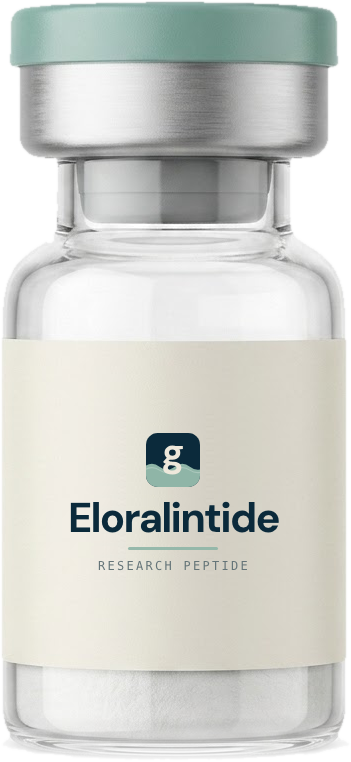
Eloralintide
Eloralintide (LY3841136) is an investigational once-weekly amylin receptor agonist from Eli Lilly, studied for weight management; its 48-week phase 2 trial gave 1, 3, 6 or 9 mg under the skin once a week. Research protocols start at 1 mg weekly and step up no faster than every 4 weeks, only if progress has stalled.
Best for
Weight-management research interest in the amylin pathway (fullness and slower stomach emptying), as an alternative or complement to GLP-1-class drugs. Not FDA-approved: it is still in clinical trials.
What to expect
Weight change was measured over 12 weeks in the phase 1 study and 48 weeks in phase 2; in phase 2, average weight change at 48 weeks ranged from -9% (1 mg) to -20% (9 mg), against -0.4% on placebo.
Pairs with
Amylin agonists are being studied alongside GLP-1-class drugs (this catalog's Retatrutide + Eloralintide is one vial of both). Do not add a second amylin agonist such as cagrilintide on top of it.
Once weekly, under the skin. Start at 1 mg; the ladder 1 → 3 → 6 → 9 mg (the phase 2 doses) is a ceiling, not a schedule — step up no faster than every 4 weeks, and only if progress has stalled.
In the 48-week trial, nausea was reported by 25% of people stepped up from 3 to 9 mg against 54% stepped up from 6 to 9 mg. Sold as 5 mg and 10 mg vials: in 1 mL of water, 1 mg is 10 units on a 10 mg vial and 20 units on a 5 mg vial.
Specific dosing varies by goal and physician guidance.
- How often
- Weekly
- When
- Morning
- Route
- Subcutaneous
- Vial & water
- 10 mg vial in 1 mL = 10 mg/mL · 1 mg = 10 units on a U-100 syringe
- Cycle
- Start 1 mg weekly; step 1 → 3 → 6 → 9 mg no faster than every 4 weeks, and only if your response has stalled.
The same numbers the goodtides app and the Dose Calc use — a research reference, not a prescription. Responses are individual; research protocols start at the low end.
No approved brand anywhere. Eloralintide is an amylin receptor agonist, not a GLP-1 agonist, and is still in clinical trials — it has never been reviewed, approved, or sold as a finished medicine. Trial figures are research reference points, not a label.
Eloralintide is a long-acting peptide agonist of the amylin receptor — the receptor for amylin, a hormone released with insulin that slows stomach emptying and signals fullness. In cell assays it preferentially activates the human amylin 1 receptor; it is not a GLP-1 agonist.
It is not FDA-approved for any use.
People have received single doses of 0.04–12 mg, weekly doses up to 12 mg for 12 weeks (phase 1) and 1–9 mg weekly for 48 weeks (phase 2), all in Lilly-funded studies; a 2026 review lists it as heading into phase 3.
References4
- Billings LK et al. Eloralintide, a selective amylin receptor agonist for the treatment of obesity: a 48-week phase 2, multicentre, double-blind, randomised, placebo-controlled trial (Lancet) (phase 2, 48 weeks)
- Bhattachar S et al. Eloralintide, a selective, long-acting amylin receptor agonist for treatment of obesity: Phase 1 proof of concept (Diabetes Obes Metab) (phase 1, 12 weeks)
- Briere DA et al. Eloralintide (LY3841136), a novel amylin receptor agonist for the treatment of obesity: From discovery to clinical proof of concept (Mol Metab) (single doses 0.04-12 mg)
- Alhazmi A, le Roux CW. Amylin Analogs: The Next Major Class of Weight Loss Therapy: A Review of Experimental Data and Early-Phase Clinical Trials (Diabetes Obes Metab) (review)
Log every dose, count every vial, and verify your batches — free in the goodtides app.
This page is educational reference material about compounds studied in research settings. It is not medical advice, and nothing here is a recommendation to buy, possess, or use any compound. Research findings described are from published literature; individual compounds may not be approved for human use. Talk to a licensed clinician about anything that affects your health.