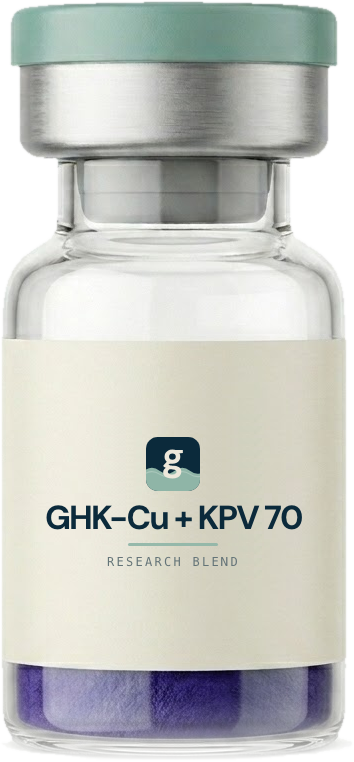
GHK-Cu + KPV 70
GHK-Cu + KPV 70 is a single premixed vial of GHK-Cu (50 mg) and KPV (20 mg) — 70 mg in 3 mL, Beauty Blend's copper with twice its KPV.
Research protocols dose it by insulin units: 5 units for maintenance (GHK-Cu 0.83 · KPV 0.33 mg), 10 units for recovery (1.67 / 0.67 mg) and 15 units for healing (GHK-Cu 2.5 · KPV 1 mg — KPV's daily research ceiling), subcutaneously.
Best for
Skin, hair and anti-inflammatory research interest with KPV weighted higher than in Beauty Blend. Because its concentration differs from the 60 mg Beauty Blend and the 110 mg Halo, their unit numbers do not transfer — Beauty Blend's 30-unit rung drawn from this vial is 2 mg of KPV.
What to expect
Research on the individual components describes gradual changes rather than acute effects: skin- and collagen-related GHK-Cu effects over several weeks of repeated exposure, and KPV's anti-inflammatory effects in mouse models over days of repeated dosing. No validated human time-to-effect for the blend is established.
Pairs with
Within this product GHK-Cu and KPV are already combined; in broader research practice both are grouped with recovery-oriented peptides such as BPC-157 and TB-500. Do not run it beside a separate GHK-Cu or KPV vial, or another copper blend, without counting both.
Premixed GHK-Cu + KPV blend (70 mg / 3 mL: GHK-Cu 16.67 + KPV 6.67 mg/mL), dosed by VOLUME.
The ladder is read in mg per component: 5 units on a U-100 syringe for maintenance (about 0.83 mg GHK-Cu and 0.33 mg KPV), 10 units for recovery (1.67 / 0.67 mg) and 15 units for healing (2.5 mg GHK-Cu and 1 mg KPV, the daily research ceiling for KPV), subcutaneously. A 0.3 mL (30-unit) syringe makes the 5-unit start easier to read.
GHK-Cu can sting — let the filled syringe reach room temperature (~20 min) before injecting.
- How often
- Daily
- Route
- Subcutaneous
- Vial & water
- 70 mg in 3 mL · 5 units ≈ 0.83 mg GHK-Cu + 0.33 mg KPV
- Cycle
- Often run in 10-20 day courses with a break, or continuously for skin/hair support - your call. Copper stings, so build the dose up slowly.
The same numbers the goodtides app and the Dose Calc use — a research reference, not a prescription. Responses are individual; research protocols start at the low end.
Two research-grade peptides in one vial — GHK-Cu (50 mg) and KPV (20 mg). GHK-Cu is a copper(II)-binding tripeptide (glycyl-L-histidyl-L-lysine) found naturally in human plasma; reviews of its laboratory and topical research describe extracellular-matrix remodeling (collagen, elastin, glycosaminoglycans) and antioxidant and anti-inflammatory gene-level effects.
KPV is a synthetic tripeptide (Lys-Pro-Val) from the C-terminus of alpha-melanocyte-stimulating hormone; in cell and mouse models it lowered pro-inflammatory cytokine secretion and intestinal inflammation. No human or animal study of the combination exists, and neither peptide is FDA-approved for human use, so this is a research-context blend.
References6
- Pickart L. The human tri-peptide GHK and tissue remodeling (J Biomater Sci Polym Ed)
- Pickart L, Margolina A. Regenerative and Protective Actions of the GHK-Cu Peptide in the Light of the New Gene Data (Int J Mol Sci)
- Pickart L, Vasquez-Soltero JM, Margolina A. GHK Peptide as a Natural Modulator of Multiple Cellular Pathways in Skin Regeneration (Biomed Res Int)
- Dalmasso G et al. PepT1-mediated tripeptide KPV uptake reduces intestinal inflammation (Gastroenterology) (mouse model)
- Kannengiesser K et al. Melanocortin-derived tripeptide KPV has anti-inflammatory potential in murine models of inflammatory bowel disease (Inflamm Bowel Dis) (murine model)
- Luger TA, Brzoska T. alpha-MSH related peptides: a new class of anti-inflammatory and immunomodulating drugs (Ann Rheum Dis)
Log every dose, count every vial, and verify your batches — free in the goodtides app.
This page is educational reference material about compounds studied in research settings. It is not medical advice, and nothing here is a recommendation to buy, possess, or use any compound. Research findings described are from published literature; individual compounds may not be approved for human use. Talk to a licensed clinician about anything that affects your health.