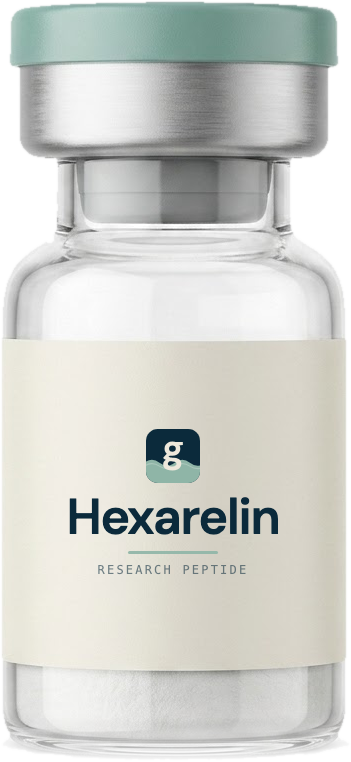
Hexarelin
Hexarelin is a synthetic hexapeptide growth-hormone secretagogue (a GHRP that agonizes the GHS-R1a receptor) studied to stimulate GH and IGF-1 release; research protocols typically use 100 mcg subcutaneously twice daily in short cycles only.
Best for
It has been studied primarily as a growth hormone secretagogue for stimulating endogenous GH and IGF-1 release, and in preclinical models for cardioprotective, metabolic, and neuroprotective effects.
What to expect
Research in humans reports peak plasma GH roughly 30 minutes after subcutaneous administration, with levels returning toward baseline within about 2 to 4 hours.
Pairs with
In research contexts it is sometimes paired with a GHRH analog such as CJC-1295 or sermorelin to study synergistic GH pulses, though its cortisol and prolactin effects make it less commonly stacked than milder secretagogues.
In research settings it has typically been administered subcutaneously in short cycles, often dosed once or twice daily, reflecting the founder handbook's emphasis on short cycles only given its tendency to raise cortisol and prolactin and the rapid receptor desensitization reported with continued use.
- How often
- Daily · 2×/day
- When
- Bedtime · Post-workout
- Route
- Subcutaneous
- Vial & water
- 10 mg vial in 3 mL = 3.33 mg/mL · 100 mcg = 3 units on a U-100 syringe
- Cycle
- 4–6 wk on, then break (downregulation risk)
The same numbers the goodtides app and the Dose Calc use — a research reference, not a prescription. Responses are individual; research protocols start at the low end.
Hexarelin (examorelin) is a synthetic hexapeptide growth hormone-releasing peptide (GHRP), sequence His-D-2-methyl-Trp-Ala-Trp-D-Phe-Lys-NH2, structurally derived from GHRP-6 with a 2-methylation of the D-tryptophan that improves metabolic stability and potency.
Hexarelin reached Phase II clinical trials for GH deficiency and congestive heart failure but was never completed or marketed; it is not FDA-approved and is handled as a research compound, with cardioprotective, metabolic and neuroprotective findings derived largely from animal models.
Research has characterized it as an agonist of the growth hormone secretagogue receptor (GHS-R1a), the same receptor activated by ghrelin, in the hypothalamus and anterior pituitary, where receptor binding triggers phospholipase-C signaling and pulsatile growth hormone release; it has also been reported to interact with the scavenger receptor CD36, a focus of preclinical cardiovascular research. Human studies have documented acute GH release alongside dose-dependent increases in prolactin, ACTH and cortisol, with HPA-axis activation attributed to arginine vasopressin rather than CRH.
- Half-life
- ~55 min plasma (reported)
- Peak
- ~30 min post-SC (plasma GH peak)
- Absorption
- Rapid following subcutaneous injection
- Bioavailability
- Low oral bioavailability; administered parenterally in research
References2
Log every dose, count every vial, and verify your batches — free in the goodtides app.
This page is educational reference material about compounds studied in research settings. It is not medical advice, and nothing here is a recommendation to buy, possess, or use any compound. Research findings described are from published literature; individual compounds may not be approved for human use. Talk to a licensed clinician about anything that affects your health.