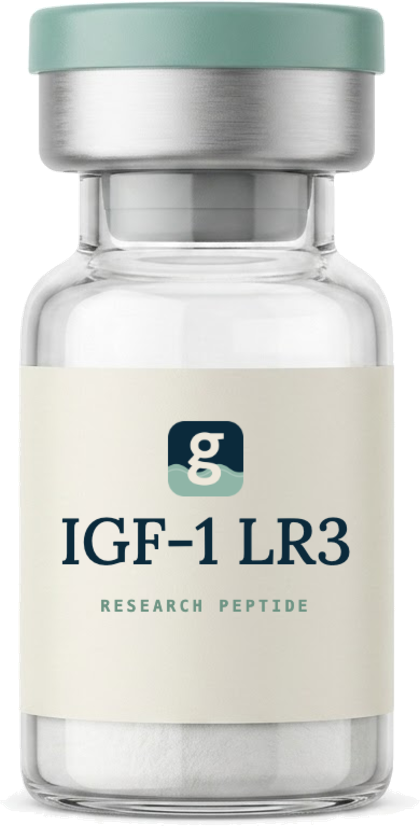
IGF-1 LR3
IGF-1 LR3 (Long R3 IGF-1) is a modified, long-acting analog of insulin-like growth factor-1 studied as a direct IGF-1 receptor agonist; research protocols are dosed in MICROGRAMS — typically a conservative 20-50 mcg per day subcutaneously. Note the unit carefully: a 1 mg vial holds 1,000 mcg, so a 20 mcg dose is only 1/50th of the vial. Confusing mcg with mg is a 1,000-fold overdose.
Best for
It has been studied as a direct IGF-1-receptor agonist in the research contexts of muscle-cell growth, protein synthesis, satellite-cell activation, and tissue repair — downstream of the growth-hormone axis rather than acting on the pituitary.
What to expect
Owing to its reduced binding-protein affinity and extended structure, research describes a relatively prolonged systemic presence (functional half-life on the order of 20-30 hours), with cellular growth and protein-synthesis effects studied over the course of a multi-week cycle rather than acutely.
Pairs with
In research stacks it is sometimes discussed alongside growth-hormone secretagogues (such as ipamorelin with CJC-1295) that raise upstream GH and endogenous IGF-1, though combining a potent exogenous IGF-1 analog with GH-axis stimulation compounds the growth signal and the associated risks, so it is typically studied on its own in conservative protocols.
In research settings it is administered as a small-volume subcutaneous injection, typically once daily with a conservative start around 20 mcg and exploratory ranges up to roughly 50 mcg per day, kept to short cycles. Because it is dosed in micrograms out of a milligram-scale vial, careful reconstitution math and an insulin syringe are essential to avoid a large accidental overdose.
- How often
- Daily
- When
- Post-workout · Morning
- Route
- Subcutaneous
- Vial & water
- 1 mg vial in 3 mL = 0.33 mg/mL · 20 mcg = 6 units on a U-100 syringe
- Cycle
- Short cycles only: ~4 weeks on, then an equal break. IGF-1 is a potent growth signal — long uninterrupted use raises theoretical concerns (receptor downregulation, hypoglycemia, unwanted tissue growth), so research-context use keeps runs brief and spaced out.
The same numbers the goodtides app and the Dose Calc use — a research reference, not a prescription. Responses are individual; research protocols start at the low end.
IGF-1 LR3 (Long R3 IGF-1) is an 83-amino-acid recombinant analog of human insulin-like growth factor-1. It carries two engineering changes from native IGF-1: an arginine substituted for glutamic acid at position 3 (the 'R3'), and a 13-amino-acid N-terminal extension (the 'Long' portion).
It is not FDA-approved for any indication and is handled strictly as a research compound; its potency as a growth signal and its overlap with insulin signaling are why research-context use emphasizes microgram dosing, short cycles, and caution around blood glucose.
Native IGF-1 is the principal downstream mediator of growth hormone — GH stimulates the liver to secrete IGF-1, which then acts on the IGF-1 receptor (a tyrosine-kinase receptor) to drive cell proliferation, protein synthesis, and anti-apoptotic signaling via the PI3K/Akt and MAPK pathways. In circulation, native IGF-1 is largely bound and inactivated by IGF-binding proteins (IGFBPs).
The R3 substitution dramatically reduces IGF-1 LR3's affinity for these binding proteins, leaving far more free, active peptide, while the N-terminal extension further slows clearance. The net effect is a substantially longer functional half-life (reported on the order of 20-30 hours versus roughly 10-20 minutes for free native IGF-1) and greater potency at the receptor.
Originally developed as a cell-culture reagent to promote growth in bioreactor cell lines, IGF-1 LR3 has no approved human therapeutic use.
References3
- Tomas FM et al. Superior potency of infused IGF-I analogues which bind poorly to IGF-binding proteins is maintained when administered by injection (rat model)
- Francis GL et al. Novel recombinant fusion protein analogues of insulin-like growth factor (IGF)-I indicate the relative importance of IGF-binding protein and receptor binding for enhanced biological potency
- Bach LA. Recent insights into the actions of IGFBP-6
Log every dose, count every vial, and verify your batches — free in the goodtides app.
This page is educational reference material about compounds studied in research settings. It is not medical advice, and nothing here is a recommendation to buy, possess, or use any compound. Research findings described are from published literature; individual compounds may not be approved for human use. Talk to a licensed clinician about anything that affects your health.