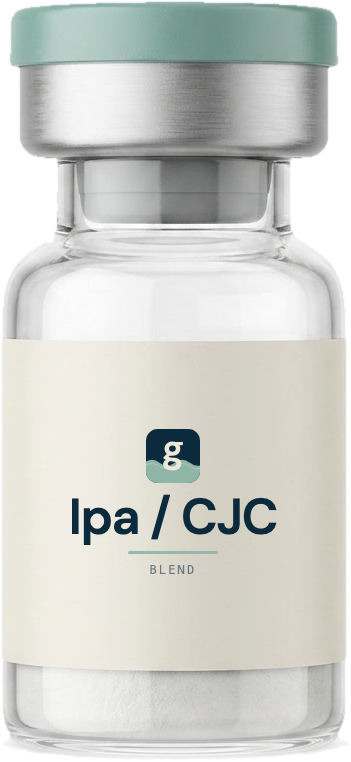
Ipamorelin + CJC-1295
Ipa/CJC is a research blend of the growth-hormone secretagogues Ipamorelin and CJC-1295 (no DAC) studied for stimulating endogenous GH and IGF-1 secretion; research protocols typically start near 100 mcg of each subcutaneously at bedtime, building toward ~300 mcg each.
Best for
It has been studied as a research tool for stimulating endogenous growth-hormone and IGF-1 secretion, with interest in body-composition, recovery, and GH/IGF-axis research contexts.
What to expect
Research on the secretagogues reports a rapid rise in plasma GH within roughly 30 to 60 minutes of administration, while changes in downstream markers such as IGF-1 are studied over days to weeks.
Pairs with
It is commonly combined as the Ipamorelin and CJC-1295 (no DAC) pairing itself, and in research discussions is sometimes considered alongside other GH-axis or recovery-oriented peptides.
In research settings the blend is typically administered by subcutaneous injection, often once or more daily and frequently timed before sleep, with the no-DAC form chosen for its short half-life to approximate natural pulsatile GH release.
- How often
- Daily · 2×/day
- When
- Bedtime · Post-workout
- Route
- Subcutaneous
- Vial & water
- 10 mg (5 each) in 3 mL · 100 mcg each = 6 units on a U-100 syringe
- Cycle
- Continuous; pause periodically to keep GH-receptor sensitivity.
The same numbers the goodtides app and the Dose Calc use — a research reference, not a prescription. Responses are individual; research protocols start at the low end.
Ipa/CJC is a research blend of two growth-hormone secretagogues that act through complementary pituitary pathways.
Ipamorelin is a synthetic pentapeptide (Aib-His-D-2-Nal-D-Phe-Lys-NH2) and a selective agonist of the ghrelin / growth-hormone-secretagogue receptor (GHSR-1a); research has characterized it as one of the most selective secretagogues, stimulating pulsatile GH release without the cortisol, ACTH, or prolactin elevations seen with earlier compounds. CJC-1295 (no DAC), also known as modified GRF 1-29, is a synthetic analog of the first 29 amino acids of growth-hormone-releasing hormone (GHRH) that binds the GHRH receptor on somatotrophs and raises intracellular cAMP.
Combining a GHRH analog with a ghrelin-receptor agonist has been studied as a way to amplify endogenous GH output through two distinct receptors. Neither component is FDA-approved; both are handled as research compounds, and human data remain limited compared with preclinical work.
References4
- Raun K et al. Ipamorelin, the first selective growth hormone secretagogue (Eur J Endocrinol)
- Gobburu JV et al. Pharmacokinetic-pharmacodynamic modeling of ipamorelin, a growth hormone releasing peptide, in human volunteers (Pharm Res)
- Teichman SL et al. Prolonged stimulation of growth hormone (GH) and insulin-like growth factor I secretion by CJC-1295, a long-acting analog of GH-releasing hormone, in healthy adults (J Clin Endocrinol Metab)
- Jette L et al. hGRF(1-29)-albumin bioconjugates activate the GRF receptor on the anterior pituitary in rats: identification of CJC-1295 as a long-lasting GRF analog (Endocrinology) (rat model)
Log every dose, count every vial, and verify your batches — free in the goodtides app.
This page is educational reference material about compounds studied in research settings. It is not medical advice, and nothing here is a recommendation to buy, possess, or use any compound. Research findings described are from published literature; individual compounds may not be approved for human use. Talk to a licensed clinician about anything that affects your health.