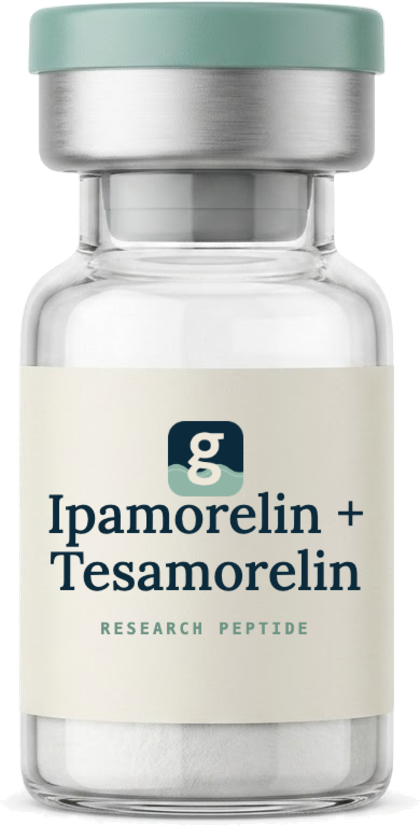
Tesamorelin + Ipamorelin 16
Tesamorelin + Ipamorelin 16 is a research-compound blend of a GHRH analog (13 mg tesamorelin) and a selective GH secretagogue (3 mg ipamorelin) in a 16 mg vial, often sold as "13/3" (the 10 mg 5 / 5 and 13 mg 10 / 3 vials are separate products); research protocols typically dose it nightly by subcutaneous injection in insulin units, in 12-week-on / 4-week-off cycles.
Best for
Growth-hormone-axis research — visceral-fat and body-composition questions in particular — where a GHRH analog is combined with a ghrelin-receptor agonist to amplify the overnight GH pulse.
What to expect
Tesamorelin trials measured visceral-fat change over 26 weeks; ipamorelin's GH pulse is acute. Body-composition changes are typically described over 12+ weeks.
Pairs with
Often run as a standalone GH-axis stack; some protocols add CJC-1295 (no DAC) or combine with metabolic peptides such as MOTS-c.
Subcutaneous injection nightly at bedtime, fasted, dosed in units from a 16 mg vial reconstituted with 2 mL of bacteriostatic water. 12 weeks on, 4 weeks off is a common pattern for growth-hormone secretagogue blends.
- How often
- 5 days on / 2 off
- When
- Bedtime
- Route
- Subcutaneous
- Vial & water
- 16 mg in 2 mL · 10 units ≈ 0.65 mg Tesamorelin + 0.15 mg Ipamorelin
- Cycle
- 12 weeks on, 4 weeks off is a common pattern for growth-hormone secretagogue blends
The same numbers the goodtides app and the Dose Calc use — a research reference, not a prescription. Responses are individual; research protocols start at the low end.
Tesamorelin is a stabilized synthetic analog of growth-hormone-releasing hormone (GHRH) that stimulates pituitary GH release through the GHRH receptor; it is FDA-approved (Egrifta) for HIV-associated lipodystrophy, where trials showed reductions in visceral adipose tissue. Ipamorelin is a pentapeptide ghrelin-receptor (GHS-R1a) agonist that triggers a GH pulse with comparatively little effect on cortisol or prolactin.
Ipamorelin is not FDA-approved; tesamorelin is approved only for its lipodystrophy indication, and non-approved uses are research-only.
The two act on complementary receptors, and the pairing is used on the rationale that a GHRH analog plus a secretagogue produces a larger, more physiological GH pulse than either alone.
References2
Log every dose, count every vial, and verify your batches — free in the goodtides app.
This page is educational reference material about compounds studied in research settings. It is not medical advice, and nothing here is a recommendation to buy, possess, or use any compound. Research findings described are from published literature; individual compounds may not be approved for human use. Talk to a licensed clinician about anything that affects your health.