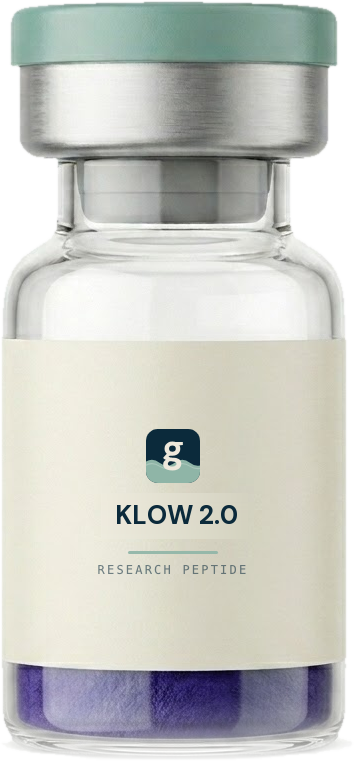
KLOW 2.0
KLOW 2.0 is a single premixed vial of the same four peptides as KLOW and KLOW Pro — GHK-Cu, BPC-157, TB-500 and KPV — in a larger 125 mg fill supplied in a 6 mL amber vial (50 / 30 / 30 / 15 mg). Its ratio sits close to KLOW Pro's, but at 6 mL of water it reconstitutes THINNER than either older blend (20.83 mg/mL against 26.67), so the same number of insulin units delivers about 22% less of every component. Dosed by units, not milligrams.
Best for
Adults already familiar with the KLOW combination who want a larger vial. Because the concentration differs from KLOW and KLOW Pro, it is a poor first introduction to the blend — the unit numbers people quote to each other come from the 80 mg / 3 mL vials and do not transfer. Four active peptides in one vial is not a first-time protocol, and physician guidance is advised.
What to expect
Multi-system effects typically develop over several weeks of consistent daily use, consistent with the individual components. Timelines vary by individual and goal.
Pairs with
Built as a broad standalone stack — its four components already cover local repair, systemic cell migration, anti-inflammatory signalling and skin support, so additional peptides are usually redundant for these goals. Running it alongside separate BPC-157 or TB-500, or alongside KLOW or KLOW Pro, would double-dose the same components.
Subcutaneous injection, dosed by insulin units rather than milligrams because it is a multi-peptide blend. The fill is 125 mg; the vial holds 6 mL, and at that volume the solution is 20.83 mg/mL.
On that basis the ladder reads: 13 units for maintenance (about 1.1 mg GHK-Cu, 0.65 mg each of BPC-157 and TB-500, 0.33 mg KPV), 27 units for recovery (2.25 / 1.35 / 1.35 / 0.68 mg) and 40 units for healing (3.3 mg GHK-Cu, 2 mg each of BPC-157 and TB-500, 1 mg KPV) — BPC-157, TB-500 and KPV all reach their daily research ceilings at 40 units, so copper tops out at 3.3 mg rather than KLOW's 5. The comparison that matters: KLOW Pro reaches that same healing split at 30 units, so a unit number carried across from Pro under-delivers here by about a fifth.
Set your actual vial size and water volume when you reconstitute rather than reusing a figure from another vial. Specific dosing varies by goal and physician guidance.
- How often
- Daily
- Route
- Subcutaneous
- Vial & water
- 125 mg in 6 mL · 13 units ≈ 1.08 mg GHK-Cu + 0.65 mg BPC-157 + 0.65 mg TB-500 + 0.33 mg KPV
- Cycle
- Continuous
The same numbers the goodtides app and the Dose Calc use — a research reference, not a prescription. Responses are individual; research protocols start at the low end.
Four peptides in one vial, each with its own literature and no published study of the combination. GHK-Cu is a naturally occurring copper-binding tripeptide studied for wound healing, skin remodelling and antioxidant signalling, and it is the largest single component here at 50 mg.
The difference that affects a dose is the fill volume: 125 mg in 6 mL is a thinner solution than 80 mg in 3 mL, and because these blends are dosed in syringe units rather than milligrams, a thinner solution means less of everything per unit.
BPC-157 is a synthetic 15-amino-acid sequence derived from a protein in gastric juice, studied preclinically for angiogenesis and tendon-to-bone healing. TB-500 is a synthetic form of thymosin beta-4, a regulator of actin polymerisation and cell migration present in nearly every nucleated cell.
KPV is a tripeptide fragment of alpha-MSH studied for anti-inflammatory signalling in the gut and skin.
What distinguishes this product from the other two KLOW vials is arithmetic rather than pharmacology. The ratio is close to KLOW Pro's — nominally 50:30:30:15, which reduces to about 3.3:2:2:1 against Pro's 3:2:2:1, so slightly more copper-weighted — and the certificate for the lot on file (Freedom Diagnostics, six vials assayed) measured a mean net content of 50.09 mg GHK-Cu, 31.08 mg BPC-157, 30.16 mg thymosin beta-4 and 14.71 mg KPV, totalling 126.04 mg against a 125 mg label.
Nothing about the peptides changed; the concentration did.
References4
- Sikiric P et al. Stable gastric pentadecapeptide BPC 157: novel therapy in gastrointestinal tract (Curr Pharm Des)
- Goldstein AL et al. Thymosin beta4: actin-sequestering protein moonlights to repair injured tissues (Trends Mol Med)
- Pickart L. The human tri-peptide GHK and tissue remodeling (J Biomater Sci Polym Ed)
- Dalmasso G et al. PepT1-mediated tripeptide KPV uptake reduces intestinal inflammation (Gastroenterology) (mouse model)
Log every dose, count every vial, and verify your batches — free in the goodtides app.
This page is educational reference material about compounds studied in research settings. It is not medical advice, and nothing here is a recommendation to buy, possess, or use any compound. Research findings described are from published literature; individual compounds may not be approved for human use. Talk to a licensed clinician about anything that affects your health.