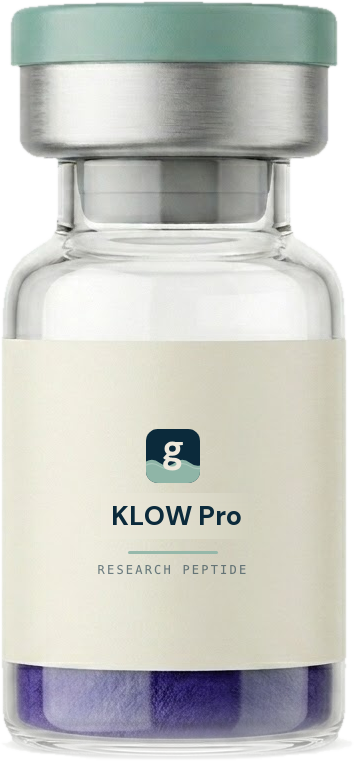
KLOW Pro
KLOW Pro is a single premixed vial combining GHK-Cu, BPC-157, TB-500 and KPV (80 mg total in 3 mL) — the same four peptides as KLOW, rebalanced toward tissue repair: copper down from 50 mg to 30 mg, BPC-157 and TB-500 doubled to 20 mg each. Research protocols dose it by insulin units, typically starting near 10 units and building toward 30.
Best for
Adults who want the KLOW combination weighted toward connective-tissue recovery rather than skin, or who found KLOW's copper content stung. Because it contains four active peptides it is not a first-time protocol, and physician guidance is advised.
What to expect
Multi-system effects typically develop over several weeks of consistent daily use, consistent with the individual components. Timelines vary by individual and goal.
Pairs with
Built as a broad standalone stack — its four components already cover local repair, systemic cell migration, anti-inflammatory signalling and skin support, so additional peptides are usually redundant for these goals. Running it alongside separate BPC-157 or TB-500 would double-dose those components.
Subcutaneous injection, dosed by insulin units rather than milligrams because it is a multi-peptide blend (80 mg total in 3 mL).
At that fill the ladder reads: 10 units for maintenance (about 1 mg GHK-Cu, 0.67 mg each of BPC-157 and TB-500, 0.33 mg KPV), 20 units for recovery (2 / 1.33 / 1.33 / 0.67 mg) and 30 units for healing (3 mg GHK-Cu, 2 mg each of BPC-157 and TB-500, 1 mg KPV) — BPC-157, TB-500 and KPV all reach their daily research ceilings there, which is why copper tops out at 3 mg rather than KLOW's 5. Compared with KLOW at the same number of units this is less copper and double the two repair peptides, so the ladder should be judged on BPC-157 and TB-500 rather than on how much the copper stings.
Localized-heal eligible: it can be injected near a target site instead of rotating the usual systemic sites. Specific dosing varies by goal and physician guidance.
- How often
- Daily
- Route
- Subcutaneous
- Vial & water
- 80 mg in 3 mL · 10 units ≈ 1 mg GHK-Cu + 0.67 mg BPC-157 + 0.67 mg TB-500 + 0.33 mg KPV
- Cycle
- Continuous
The same numbers the goodtides app and the Dose Calc use — a research reference, not a prescription. Responses are individual; research protocols start at the low end.
KLOW Pro is a single premixed vial combining four research-grade peptides — GHK-Cu (30 mg), BPC-157 (20 mg), TB-500 (20 mg) and KPV (10 mg), for 80 mg total in 3 mL.
It carries the same components as KLOW at a different ratio: KLOW is copper-weighted at 50 mg GHK-Cu with 10 mg each of the others, while Pro halves the copper and doubles the two repair peptides. The vial total is identical, so the difference shows up per unit drawn, not on the label.
BPC-157 is a 15-amino-acid pentadecapeptide derived from a protective protein found in gastric juice; research describes support for angiogenesis in injured tissue, modulation of growth-factor pathways including FGF and VEGF, and accelerated tendon-to-bone healing in animal models, acting primarily at the local injury site. TB-500, a synthetic version of thymosin beta-4, is a fragment of a 43-amino-acid peptide present in nearly every nucleated human cell and a major regulator of actin polymerisation and cell migration; it is studied as a systemic actor that recruits repair cells from distant sites.
Pairing local repair with systemic migration is the classic complementary recovery stack, and doubling both is what the Pro ratio is for.
KPV, a Lys-Pro-Val tripeptide and the C-terminal fragment of alpha-MSH, has documented anti-inflammatory activity via NF-κB pathway modulation in animal and cell models. GHK-Cu, a Gly-His-Lys copper-peptide complex, is studied for collagen synthesis, skin quality and hair-follicle health; the copper can sting at the injection site, so let the filled syringe reach room temperature for about 20 minutes and inject slowly.
At 30 mg the sting is milder than KLOW's, and the skin-directed share of the blend is correspondingly smaller.
None of these peptides is FDA-approved for human use, so this is strictly a research-context blend, and the evidence for each component is largely preclinical. Because a blend's components can each test differently against the label, dosing should follow the lab-measured milligrams for the specific lot rather than the printed split.
References4
- Sikiric P et al. Stable gastric pentadecapeptide BPC 157: novel therapy in gastrointestinal tract (Curr Pharm Des)
- Goldstein AL et al. Thymosin beta4: actin-sequestering protein moonlights to repair injured tissues (Trends Mol Med)
- Pickart L. The human tri-peptide GHK and tissue remodeling (J Biomater Sci Polym Ed)
- Dalmasso G et al. PepT1-mediated tripeptide KPV uptake reduces intestinal inflammation (Gastroenterology) (mouse model)
Log every dose, count every vial, and verify your batches — free in the goodtides app.
This page is educational reference material about compounds studied in research settings. It is not medical advice, and nothing here is a recommendation to buy, possess, or use any compound. Research findings described are from published literature; individual compounds may not be approved for human use. Talk to a licensed clinician about anything that affects your health.