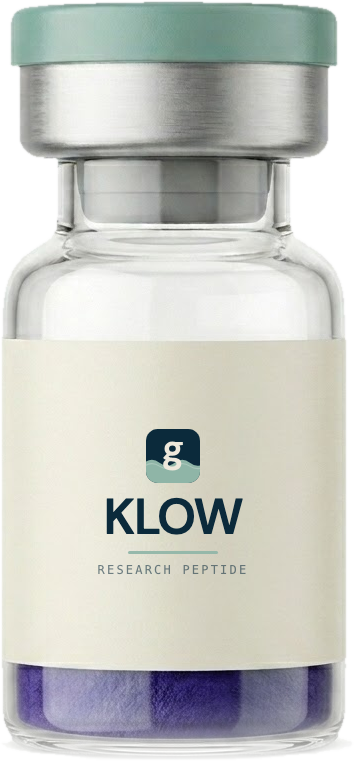
KLOW
KLOW is a single premixed vial combining BPC-157, TB-500, KPV, and GHK-Cu (80 mg total in 3 mL) for recovery, skin, and immune support; research protocols dose by insulin units, starting around 10 units and building toward 30 units (about 5 mg GHK-Cu/day) subcutaneously.
Best for
Adults seeking combined connective-tissue recovery, skin and hair support, and anti-inflammatory signaling in one multi-peptide vial. Because it contains four active peptides, it is not recommended as a first-time peptide protocol; physician guidance is advised.
What to expect
Multi-system effects (recovery, skin, inflammation) typically develop over several weeks of consistent daily use, consistent with its individual components. Timelines vary by individual and goal.
Pairs with
Built as a broad standalone stack — its four components already cover local repair, systemic migration, anti-inflammatory signaling, and skin/collagen support, so additional peptides are usually redundant for these goals.
Subcutaneous injection, dosed by insulin units rather than milligrams because it is a multi-peptide blend (80 mg total in 3 mL).
The ladder is read in mg per component: 10 units for maintenance (about 1.7 mg GHK-Cu and 0.33 mg each of BPC-157, TB-500 and KPV), 20 units for recovery (3.3 mg GHK-Cu, 0.67 mg each) and 30 units for healing (5 mg GHK-Cu, 1 mg each) — copper's 5 mg daily research ceiling is what caps this blend, before BPC-157 or TB-500 reach their 2 mg. Localized-heal eligible: it can be injected near a target site instead of rotating the usual systemic sites.
GHK-Cu (copper) can sting at the injection site — after drawing your dose, set the filled syringe on the counter for about 20 minutes to reach room temperature, then inject slowly. Specific dosing varies by goal and physician guidance.
- How often
- Daily
- Route
- Subcutaneous
- Vial & water
- 80 mg in 3 mL · 10 units ≈ 1.67 mg GHK-Cu + 0.33 mg BPC-157 + 0.33 mg TB-500 + 0.33 mg KPV
- Cycle
- Continuous
The same numbers the goodtides app and the Dose Calc use — a research reference, not a prescription. Responses are individual; research protocols start at the low end.
KLOW is a single premixed vial combining four research-grade peptides — BPC-157 (10 mg), TB-500 (10 mg), KPV (10 mg), and GHK-Cu (50 mg), for 80 mg total in 3 mL — built to cover recovery, skin, and immune pathways at once.
BPC-157 is a 15-amino-acid pentadecapeptide derived from a protective protein found in gastric juice; research suggests it supports angiogenesis (new blood-vessel formation in injured tissue), modulates growth-factor pathways including FGF and VEGF, and accelerates tendon-to-bone healing in animal models, acting primarily at the local injury site. TB-500, a synthetic version of Thymosin Beta-4, is a 43-amino-acid peptide present in nearly every nucleated human cell and a major regulator of actin polymerization and cell migration; it promotes systemic cellular migration and recruitment of repair cells from distant sites.
Pairing local repair (BPC-157) with systemic migration (TB-500) is the classic complementary recovery stack. KPV, a Lys-Pro-Val tripeptide and C-terminal fragment of alpha-MSH, has documented anti-inflammatory effects via NF-κB pathway modulation.
GHK-Cu, a Gly-His-Lys copper-peptide complex, is studied for collagen synthesis, skin quality, and hair-follicle health; the copper can sting at the injection site, so let the filled syringe reach room temperature (about 20 minutes) and inject slowly. None of these peptides is FDA-approved for human use, so this is strictly a research-context blend; because it combines four active peptides it is not a first-time protocol and physician guidance is advised.
Each batch is independently lab-tested for identity and purity across all four components per our standard COA process.
References4
- Sikiric P et al. Stable gastric pentadecapeptide BPC 157: novel therapy in gastrointestinal tract (Curr Pharm Des)
- Goldstein AL et al. Thymosin beta4: actin-sequestering protein moonlights to repair injured tissues (Trends Mol Med)
- Pickart L. The human tri-peptide GHK and tissue remodeling (J Biomater Sci Polym Ed)
- Dalmasso G et al. PepT1-mediated tripeptide KPV uptake reduces intestinal inflammation (Gastroenterology) (mouse model)
Log every dose, count every vial, and verify your batches — free in the goodtides app.
This page is educational reference material about compounds studied in research settings. It is not medical advice, and nothing here is a recommendation to buy, possess, or use any compound. Research findings described are from published literature; individual compounds may not be approved for human use. Talk to a licensed clinician about anything that affects your health.