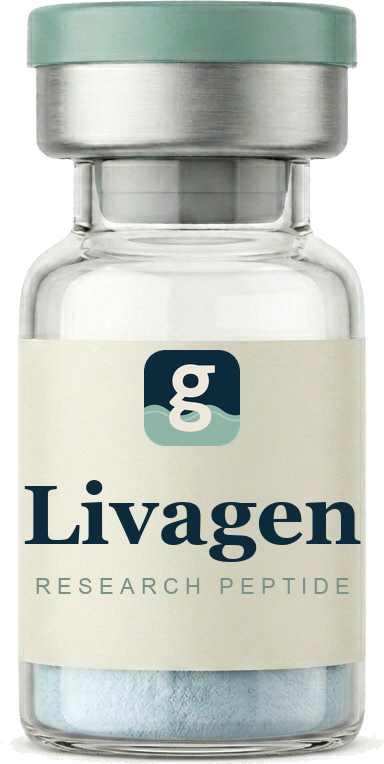
Livagen
Livagen is a synthetic tetrapeptide (Lys-Glu-Asp-Ala, abbreviated KEDA) from the Khavinson bioregulator program, derived from liver tissue and studied mainly for its reported effects on chromatin condensation in cells from elderly donors; research protocols typically use 10 mg sublingually each morning in short 10-14 day courses. All of the published work is ex vivo or animal work from one research group.
Best for
Adults researching the Khavinson bioregulator class for hepatic or chromatin-aging signalling. It is a research-interest compound, not a treatment for any liver condition — anyone with elevated liver enzymes or diagnosed liver disease needs a hepatology workup, not a research peptide.
What to expect
No human onset data. The 10-14 day cyclic course is a dosing convention from the source literature, not a measured time-to-effect window.
Pairs with
Grouped in the bioregulator literature with the other tissue-directed Khavinson peptides (Cardiogen, Vesugen, Testagen), conventionally as separate short courses. No combination has been studied, and it should not be layered onto other compounds that burden the liver.
Sublingual, once daily in the morning. The catalog reference is 10 mg per day, with a research range of 5-20 mg (5 mg as a conservative start, 20 mg at the high end), taken as cyclic 10-14 day courses rather than continuously. Research references only, not a clinical regimen.
- How often
- Daily
- When
- Morning
- Route
- Sublingual
- Cycle
- Cyclic 10–14 day courses — not continuous.
The same numbers the goodtides app and the Dose Calc use — a research reference, not a prescription. Responses are individual; research protocols start at the low end.
Livagen is the tetrapeptide Lys-Glu-Asp-Ala, synthesized by Khavinson's group as the defined-molecule form of a liver tissue extract. Its distinguishing published finding is chromatin-level rather than hepatic.
Livagen is not approved by any regulator, no controlled human trial exists, and the entire literature traces to a single group's program.
A 2002 study in Bulletin of Experimental Biology and Medicine examined lymphocytes from elderly donors and reported that Livagen activated ribosomal genes, decondensed pericentromeric structural heterochromatin, and released genes the authors described as repressed by age-related condensation of euchromatic regions — a process they termed de-heterochromatinization. A 2004 follow-up in subjects aged 75-88 compared several short peptides (Vilon, Epithalon, Livagen, Prostamax, Cortagen) and reported that all of them activated ribosomal genes and decondensed densely packed chromatin fibrils, with Epithalon and Livagen producing changes at both chromosome 1 and chromosome 9 pericentromeric regions.
A 2005 rat study reported age-dependent changes in digestive-enzyme activity in the gastrointestinal tract and non-digestive organs after Livagen administration. The framing that matters: these are ex vivo cell-culture and animal experiments, not clinical trials.
Chromatin decondensation in donor lymphocytes is a laboratory observation, not a demonstrated health outcome, and the direction of that effect is not automatically desirable.
- Half-life
- Not established in humans. Peptides this short are expected to be cleaved rapidly by plasma and gut peptidases.
- Peak
- Not established — no human pharmacokinetic study published
- Absorption
- Sublingual or oral in the cited course protocols; no measured human absorption data exists
- Bioavailability
- Not measured in humans
References4
- Effects of Livagen peptide on chromatin activation in lymphocytes from old people
- Effects of short peptides on lymphocyte chromatin in senile subjects
- Effect of peptide Livagen on activity of digestive enzymes in gastrointestinal tract and non-digestive organs in rats of different ages
- PubChem - Livagen Compound Summary, CID 87919683
Log every dose, count every vial, and verify your batches — free in the goodtides app.
This page is educational reference material about compounds studied in research settings. It is not medical advice, and nothing here is a recommendation to buy, possess, or use any compound. Research findings described are from published literature; individual compounds may not be approved for human use. Talk to a licensed clinician about anything that affects your health.