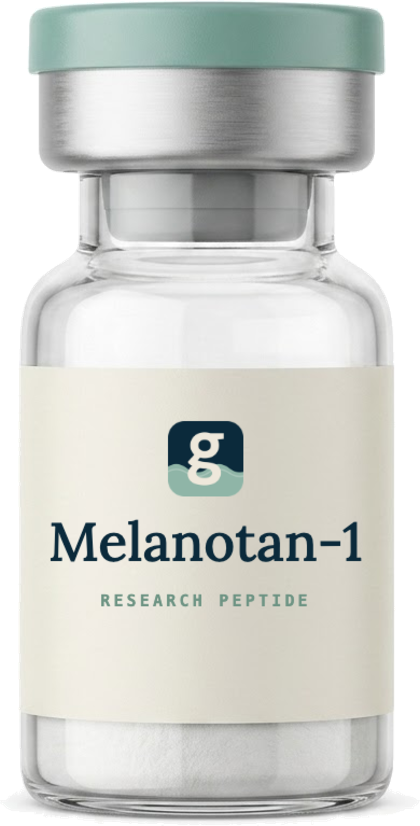
Melanotan I
Melanotan-1 (afamelanotide) is a synthetic linear analog of alpha-melanocyte-stimulating hormone (alpha-MSH) that selectively activates the melanocortin-1 receptor (MC1R) on melanocytes. It is studied for its ability to stimulate eumelanin production, producing skin darkening and increased UV photoprotection. It differs from Melanotan-2 in being highly MC1R-selective, so it lacks MT-2's pronounced appetite and libido effects.
Best for
Research contexts focused on melanogenesis, UV photoprotection, and fair (Fitzpatrick I-II) skin phototype pigmentation studies.
What to expect
Visible pigment changes generally develop gradually over 1-2 weeks of daily dosing, deepening with continued exposure to UV or the peptide.
Pairs with
Typically run standalone; a photoprotective/pigment agent rather than a stack component.
In human research the free peptide is given subcutaneously, most commonly 0.25-1 mg once daily, with a conservative starting point of 0.25 mg/day. Doses are individualized to skin type, and a loading period of daily injections is typically followed by reduced maintenance dosing.
- How often
- Daily
- When
- Morning
- Route
- Subcutaneous
- Vial & water
- 10 mg vial in 3 mL = 3.33 mg/mL · 0.25 mg = 7.5 units on a U-100 syringe
- Cycle
- Loading phase of daily doses to build pigment, then a reduced maintenance frequency; typically run in defined multi-week cycles rather than indefinitely.
The same numbers the goodtides app and the Dose Calc use — a research reference, not a prescription. Responses are individual; research protocols start at the low end.
Melanotan-1 is the research designation for afamelanotide, a synthetic 13-amino-acid analog of the natural hormone alpha-MSH, modified at positions 4 and 7 ([Nle4, D-Phe7]-alpha-MSH) to resist enzymatic breakdown and prolong receptor activity relative to native alpha-MSH.
It is important to be clear that the injectable research peptide sold as 'Melanotan-1' is NOT the same as an approved medicine, is not FDA-approved for tanning or cosmetic use, and is offered for research use only.
It acts as a potent agonist at the melanocortin-1 receptor (MC1R) expressed on epidermal melanocytes; MC1R activation raises intracellular cyclic AMP, upregulating tyrosinase and shifting melanin synthesis toward eumelanin, the darker, more photoprotective pigment. Clinical pharmacology studies of the free peptide report short plasma exposure after subcutaneous dosing, whereas the approved clinical product uses a slow-release subcutaneous implant to sustain levels.
Controlled research has shown meaningful increases in skin eumelanin content in fair-skinned subjects, and afamelanotide as a sustained-release implant (Scenesse) is approved in some jurisdictions specifically for erythropoietic protoporphyria to reduce phototoxic reactions. Long-term safety of unregulated injectable use has not been established, and because melanocortin agonists can affect pre-existing pigmented lesions, dermatologic monitoring of moles and skin is prudent.
Anyone considering it should do so only under qualified physician guidance; nothing here is medical advice.
References4
- Ugwu SO, Dorr RT et al. - Skin pigmentation and pharmacokinetics of melanotan-I in humans (Biopharm Drug Dispos)
- Barnetson RS et al. - [Nle4-D-Phe7]-alpha-MSH significantly increased pigmentation and decreased UV damage in fair-skinned Caucasian volunteers (J Invest Dermatol)
- Langendonk JG et al. - Afamelanotide for erythropoietic protoporphyria (N Engl J Med), the phase 3 trials behind the approved implant
- DailyMed - SCENESSE (afamelanotide) implant FDA prescribing information
Log every dose, count every vial, and verify your batches — free in the goodtides app.
This page is educational reference material about compounds studied in research settings. It is not medical advice, and nothing here is a recommendation to buy, possess, or use any compound. Research findings described are from published literature; individual compounds may not be approved for human use. Talk to a licensed clinician about anything that affects your health.