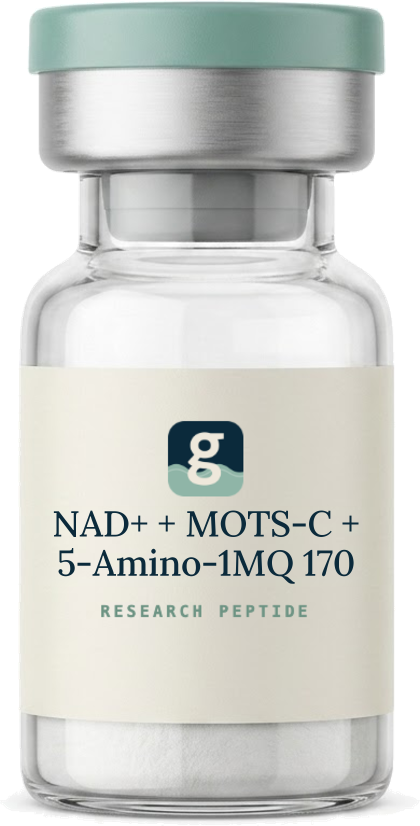
NAD+ + MOTS-c + 5-Amino-1MQ 170
NAD+ + MOTS-C + 5-Amino-1MQ 170 is a single premixed vial of NAD+ (150 mg), MOTS-C (10 mg) and 5-Amino-1MQ (10 mg) — 170 mg total, a different mix from the 120 mg vial (100 / 10 / 10).
Mixed with 3 mL of bacteriostatic water it is dosed in insulin units: 10 units to start (NAD+ 5 · MOTS-C 0.33 · 5-Amino-1MQ 0.33 mg), 20 units (10 / 0.67 / 0.67 mg) and 30 units at the top (NAD+ 15 · MOTS-C 1 · 5-Amino-1MQ 1 mg), every other day.
Best for
The same combined mitochondrial-energy and metabolic research interest as the 120 mg vial, with more NAD+ per unit. Because it combines three active compounds it is not a first peptide protocol; physician guidance is advised.
What to expect
Energy and recovery changes are often reported over the first weeks and metabolic-marker shifts over 8–12 weeks; no human study of the combination measured either.
Pairs with
Built as a self-contained mitochondrial and metabolic stack. Do not run it beside the 120 mg vial or a separate NAD+, MOTS-C or 5-Amino-1MQ product without counting each compound; add metabolic or GLP-1 agents only under physician guidance (overlapping glucose effects).
Subcutaneous injection every other day or 2–3 times a week, morning or pre-workout, dosed by insulin units because it is a multi-compound blend.
Reconstitute with 3 mL BAC water (50 mg/mL NAD+, 3.33 mg/mL each of MOTS-C and 5-Amino-1MQ) — the same MOTS-C and 5-Amino-1MQ per unit as the 120 mg vial, with 1.5x the NAD+. The ladder: 10 units = NAD+ 5 · MOTS-C 0.33 · 5-Amino-1MQ 0.33 mg, 20 units = 10 / 0.67 / 0.67 mg, 30 units = 15 / 1 / 1 mg.
Push slowly: the NAD+ component flushes if injected fast. Typically 8 weeks on, 4 weeks off.
Specific dosing varies by goal and physician guidance.
- How often
- Every other day
- When
- Morning · Pre-workout
- Route
- Subcutaneous
- Vial & water
- 170 mg in 3 mL · 10 units ≈ 5 mg NAD+ + 0.33 mg MOTS-c + 0.33 mg 5-Amino-1MQ
- Cycle
- 8 weeks on, 4 weeks off — the MOTS-C and 5-Amino-1MQ components are typically cycled; the NAD+ component can otherwise run continuously
The same numbers the goodtides app and the Dose Calc use — a research reference, not a prescription. Responses are individual; research protocols start at the low end.
Three research compounds that converge on mitochondrial energy and metabolic regulation, in one injectable vial. NAD+ (nicotinamide adenine dinucleotide) is the coenzyme of mitochondrial electron transport, PARP-driven DNA repair and the sirtuins; one human pilot study gave it by intravenous infusion, and no under-the-skin dosing study was found.
MOTS-C is a 16-amino-acid peptide encoded in mitochondrial DNA, linked in research to AMPK activation and insulin sensitivity; its dosing studies are in mice and rats. 5-Amino-1MQ is a small-molecule inhibitor of nicotinamide N-methyltransferase (NNMT), studied in cells, mice and rats; it has no published human dosing by any route. No study of the three together exists, and none is FDA-approved for human use.
References4
- Grant R et al. A Pilot Study Investigating Changes in the Human Plasma and Urine NAD+ Metabolome During a 6 Hour Intravenous Infusion of NAD (Front Aging Neurosci) (IV infusion)
- Reynolds JC et al. MOTS-c is an exercise-induced mitochondrial-encoded regulator of age-dependent physical decline and muscle homeostasis (Nat Commun) (MOTS-c dosing in mice)
- Awosemo O et al. Development & validation of LC-MS/MS assay for 5-amino-1-methyl quinolinium in rat plasma: Application to pharmacokinetic and oral bioavailability studies (J Pharm Biomed Anal) (rat)
- Babula JJ et al. Nicotinamide N-methyltransferase inhibition mitigates obesity-related metabolic dysfunction (Diabetes Obes Metab) (mouse)
Log every dose, count every vial, and verify your batches — free in the goodtides app.
This page is educational reference material about compounds studied in research settings. It is not medical advice, and nothing here is a recommendation to buy, possess, or use any compound. Research findings described are from published literature; individual compounds may not be approved for human use. Talk to a licensed clinician about anything that affects your health.