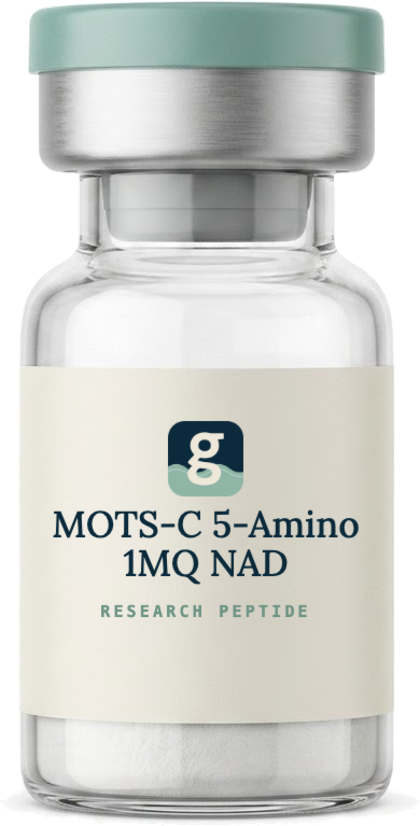
NAD+ + MOTS-c + 5-Amino-1MQ 120
This is a single premixed vial combining NAD+ (100 mg), MOTS-C (10 mg), and 5-Amino-1MQ (10 mg) — 120 mg total; the 150 / 10 / 10 mg vial is a separate product, the 170 — for cellular-energy, mitochondrial, and metabolic support; reconstituted with 3 mL BAC water it is dosed by insulin units, with a common research approach starting around 10 units (≈0.1 mL) and building toward 30 units (≈0.3 mL), subcutaneously.
Best for
Adults seeking a combined mitochondrial-energy and metabolic-flexibility protocol — declining energy, sluggish recovery, insulin-sensitivity or body-composition goals, or longevity-oriented cellular support — in one multi-compound vial. Because it combines three active compounds, it is not recommended as a first peptide protocol; physician guidance is advised.
What to expect
Energy and recovery changes are often reported over the first 2–4 weeks; metabolic-marker and exercise-capacity shifts (insulin sensitivity, body composition) develop over 8–12 weeks of consistent use. Timelines vary by individual and goal.
Pairs with
The blend is built to be broadly self-contained for mitochondrial and metabolic goals. In research contexts it is sometimes discussed alongside NAD+ precursors (NMN, NR) for sustained NAD+ levels, or with other mitochondria-targeted compounds like SS-31; stacking additional metabolic or GLP-1 agents should be done only under physician guidance to avoid overlapping glucose effects.
Subcutaneous injection, dosed by insulin units rather than milligrams because it is a multi-compound blend (120 mg total — 100 mg NAD+ / 10 mg MOTS-C / 10 mg 5-Amino-1MQ).
Reconstitute with 3 mL BAC water (~33 mg/mL NAD+ and ~3.3 mg/mL each of MOTS-C and 5-Amino-1MQ), so each 0.1 mL / 10 units delivers roughly 3.3 mg NAD+, 0.33 mg MOTS-C and 0.33 mg 5-Amino-1MQ, and a 0.3 mL / 30-unit draw about 10 mg NAD+, 1 mg MOTS-C and 1 mg 5-Amino-1MQ. A common research-context approach starts at ~10 units (≈0.1 mL) and builds toward ~30 units (≈0.3 mL) as tolerated, roughly every-other-day or 2–3× per week in the morning or pre-workout.
Push slowly: the NAD+ component causes a warm/flushing sensation across the chest and face if injected too fast — this is self-limited within minutes. Typically run 8 weeks on, then 4 weeks off (the MOTS-C and 5-Amino-1MQ components are usually cycled).
Specific dosing varies by goal and physician guidance.
- How often
- Every other day
- When
- Morning · Pre-workout
- Route
- Subcutaneous
- Vial & water
- 120 mg in 3 mL · 10 units ≈ 3.33 mg NAD+ + 0.33 mg MOTS-c + 0.33 mg 5-Amino-1MQ
- Cycle
- 8 weeks on, 4 weeks off — the MOTS-C and 5-Amino-1MQ components are typically cycled; the NAD+ component can otherwise run continuously
The same numbers the goodtides app and the Dose Calc use — a research reference, not a prescription. Responses are individual; research protocols start at the low end.
This blend combines three research compounds that converge on mitochondrial energy and metabolic regulation — NAD+ (100 mg), MOTS-C (10 mg), and 5-Amino-1MQ (10 mg), for 120 mg total, in a single injectable vial.
NAD+ (Nicotinamide Adenine Dinucleotide) is a fundamental coenzyme required for electron transport in mitochondrial ATP production, DNA repair via PARP enzymes, and the activity of sirtuins (NAD+-dependent longevity-signaling enzymes); cellular NAD+ declines roughly 50% between ages 40 and 60, and direct subcutaneous administration bypasses the gastrointestinal degradation that limits oral precursors like NMN and NR. MOTS-C is a 16-amino-acid 'mitokine' — one of the few peptides encoded in mitochondrial DNA (the 12S rRNA region) — discovered in 2015 at USC; research characterizes its role in AMPK-pathway activation, skeletal-muscle glucose uptake, insulin sensitivity, and exercise capacity, and plasma levels decline with age and inversely track insulin resistance. 5-Amino-1MQ is a small-molecule inhibitor of nicotinamide N-methyltransferase (NNMT), an enzyme overexpressed in adipose tissue that consumes NAD+ precursors and drives fat storage; inhibiting NNMT has been shown in mouse models to raise cellular NAD+ and SAM levels and reverse high-fat-diet-induced obesity.
The rationale for combining the three is complementary: MOTS-C and 5-Amino-1MQ both act to preserve and route the NAD+ pool that the NAD+ component directly replenishes, targeting cellular energy and metabolic flexibility from three angles at once. None of these compounds is FDA-approved for human use, so this is strictly a research-context blend; because it combines three actives it is not a first-time protocol and physician guidance is advised.
Each batch is independently lab-tested for identity and purity across all components per our standard COA process.
References3
- Neelakantan H et al. - Selective and membrane-permeable small molecule inhibitors of nicotinamide N-methyltransferase (5-amino-1MQ) reverse high-fat-diet-induced obesity (Biochem Pharmacol) (mouse model)
- Lee C et al. - The mitochondrial-derived peptide MOTS-c promotes metabolic homeostasis and reduces obesity and insulin resistance (Cell Metab) (mouse model)
- Rajman L, Chwalek K, Sinclair DA - Therapeutic potential of NAD-boosting molecules: the in vivo evidence (Cell Metab) (review)
Log every dose, count every vial, and verify your batches — free in the goodtides app.
This page is educational reference material about compounds studied in research settings. It is not medical advice, and nothing here is a recommendation to buy, possess, or use any compound. Research findings described are from published literature; individual compounds may not be approved for human use. Talk to a licensed clinician about anything that affects your health.