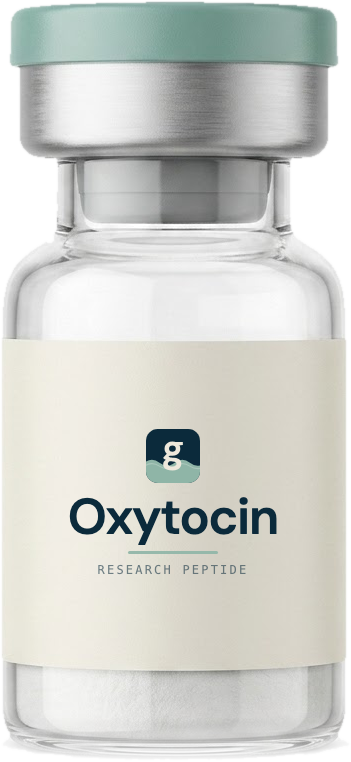
Oxytocin
Oxytocin is a nine-amino-acid cyclic peptide hormone studied for social cognition and affiliative behavior; behavioral research protocols typically use about 10-24 IU intranasally as a single dose before a task.
Best for
Researched for social cognition and affiliative behavior (trust, empathy, emotion recognition) and explored in studies of autism spectrum conditions, anxiety, PTSD, and mood, as well as its established peripheral roles in labor and lactation.
What to expect
Following intranasal dosing, research reports peak plasma exposure within roughly 15-45 minutes, and study protocols generally assess central/behavioral effects around 40-60 minutes post-administration.
Pairs with
In research and protocol contexts it is sometimes paired with behavioral or therapy-based interventions and other hormonal or mood-oriented peptides, though combination evidence is limited and not established as safe or effective.
In behavioral research, oxytocin has most commonly been administered intranasally as a single dose (frequently in the ~24 IU range) prior to a task, with cognitive and neurobiological measures typically assessed 40-60 minutes after administration; this reflects research use, not a recommendation.
- How often
- Daily
- When
- Morning
- Route
- Intranasal
- Cycle
- Continuous
The same numbers the goodtides app and the Dose Calc use — a research reference, not a prescription. Responses are individual; research protocols start at the low end.
Oxytocin is a nine-amino-acid cyclic peptide (nonapeptide) hormone with a disulfide-bridged six-residue ring, synthesized in the hypothalamus and released from the posterior pituitary.
The injectable form is FDA-approved for obstetric use (labor induction, postpartum); however, intranasal and other formulations used to study social, mood, and behavioral effects are NOT FDA-approved for those uses and are handled as research compounds.
It acts primarily on the oxytocin receptor (OXTR), a class I (rhodopsin-type) G-protein-coupled receptor coupled to the Gq/11 pathway; activation drives phospholipase C signaling, IP3 generation, and intracellular calcium release, with effects that vary by tissue and receptor density. Peripherally it has long been characterized in uterine contraction and milk let-down, while a large body of research has studied centrally acting (commonly intranasal) oxytocin for its role in social and affiliative behavior.
Reviewers note the evidence for therapeutic utility in psychiatric and social-behavioral contexts remains limited and methodologically debated.
- Half-life
- ~1-6 min plasma (IV); longer apparent half-life intranasally
- Peak
- ~15-45 min post-intranasal; effects assessed ~40-60 min
- Absorption
- Intranasal (nose-to-brain route assumed for central effects); also parenteral
- Bioavailability
- Low and highly variable intranasally
References3
Log every dose, count every vial, and verify your batches — free in the goodtides app.
This page is educational reference material about compounds studied in research settings. It is not medical advice, and nothing here is a recommendation to buy, possess, or use any compound. Research findings described are from published literature; individual compounds may not be approved for human use. Talk to a licensed clinician about anything that affects your health.