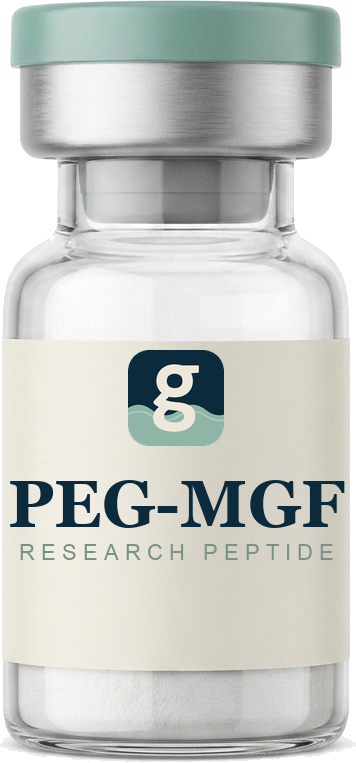
PEG-MGF
PEG-MGF is a pegylated, long-acting form of mechano growth factor (MGF) — the IGF-1Ec splice variant's C-terminal E-domain peptide — studied preclinically for satellite-cell activation and local skeletal-muscle repair; research protocols typically use 100-400 mcg (commonly ~200 mcg) subcutaneously on training days, post-workout. Note the dose is in MICROGRAMS (mcg), not milligrams — a 1000x difference.
Best for
It has been studied primarily in preclinical models for local skeletal-muscle repair, satellite (muscle stem) cell activation, and hypertrophy following mechanical overload or injury, with additional research interest in muscle-wasting and cardiac-tissue contexts. It is used strictly as a research compound and is not an approved therapy.
What to expect
No validated human time-to-effect has been established. Native MGF acts locally over hours-to-days after mechanical stress; pegylation extends systemic exposure, and any hypertrophy-related endpoints in animal research are characterized over multi-week study periods rather than acutely.
Pairs with
In research and anecdotal contexts it is sometimes discussed alongside growth-hormone secretagogues (e.g. GHRH/GHRP compounds) or standard IGF-1/GH-axis peptides, with the idea of pairing a systemic GH pulse with a local repair signal; controlled human stacking data are lacking.
Research literature on injectable PEG-MGF protocols is limited and not standardized; documented research dosing sits in the microgram range — commonly cited as roughly 100-400 mcg per administration (a frequently referenced starting point is ~200 mcg), given subcutaneously on training days shortly after exercise to coincide with the mechanical-loading repair window.
The pegylation is intended to extend the very short native MGF half-life so less frequent dosing (e.g. a few times weekly rather than daily) is used. Reconstitute the 2 mg vial with 2 mL bacteriostatic water (1000 mcg/mL) and draw carefully — at 1000 mcg/mL, a 200 mcg dose is only 20 units on a U-100 insulin syringe.
- How often
- post-workout
- When
- Post-workout
- Route
- Subcutaneous
- Vial & water
- 2 mg vial in 2 mL = 1 mg/mL · 100 mcg = 10 units on a U-100 syringe
- Cycle
- Training days only, immediately post-workout (local repair window); commonly run in short blocks (e.g. 4-6 weeks on) with breaks. Cycling is optional — adjust to goals.
The same numbers the goodtides app and the Dose Calc use — a research reference, not a prescription. Responses are individual; research protocols start at the low end.
PEG-MGF (pegylated mechano growth factor) is a research-grade, pegylated analog of MGF, the IGF-1Ec splice variant produced by exercised or damaged skeletal muscle.
Where the full IGF-1 gene can be alternatively spliced, MGF corresponds to the unique C-terminal E-domain peptide (a 24-amino-acid sequence in the human IGF-1Ec isoform) that is cleaved from the IGF-1 mature region. In muscle research MGF is characterized as an early, local response to mechanical overload: it is studied for activating and proliferating satellite (muscle stem) cells and delaying their differentiation, thereby expanding the pool available for repair and hypertrophy, with signaling reported to act through a mechanism partly distinct from the classic IGF-1 receptor pathway.
Native MGF is degraded within minutes; attaching polyethylene glycol (pegylation) is intended to protect the peptide from rapid proteolysis and extend its circulating half-life so a systemic injection can sustain exposure. None of this is FDA-approved; PEG-MGF is not a drug and is handled as a research compound, with most characterization coming from cell and animal studies rather than validated human trials.
References3
- Yang SY, Goldspink G. Different roles of the IGF-I Ec peptide (MGF) and mature IGF-I in myoblast proliferation and differentiation (in vitro)
- Goldspink G. Mechanical signals, IGF-I gene splicing, and muscle adaptation
- Hill M, Goldspink G. Expression and splicing of the insulin-like growth factor gene in rodent muscle is associated with muscle satellite (stem) cell activation following local tissue damage (rodent model)
Log every dose, count every vial, and verify your batches — free in the goodtides app.
This page is educational reference material about compounds studied in research settings. It is not medical advice, and nothing here is a recommendation to buy, possess, or use any compound. Research findings described are from published literature; individual compounds may not be approved for human use. Talk to a licensed clinician about anything that affects your health.