SLU-PP-915
SLU-PP-915 is a small-molecule pan-agonist of the estrogen-related receptors ERR-alpha, beta, and gamma — the same target as SLU-PP-332, on a different chemical scaffold, built specifically because SLU-PP-332 has no oral bioavailability. It is entirely preclinical: every in vivo study is in mice, no ERR agonist has ever been given to a human, and there is no established human dose. It is also a small molecule, not a peptide.
Best for
Reference only, for adults following preclinical exercise-mimetic pharmacology. There is no human safety profile, no phase I, no regulatory approval anywhere, and no human dose — nothing in the published literature supports self-administration. Anti-doping laboratories have published detection methods for it, so it is disqualifying in any tested sport.
What to expect
Unknown in humans. In mice the transcriptional response is fast — ERR target genes in quadriceps muscle were raised one hour after a single injection — while measurable performance and organ-level changes required repeated dosing: treadmill running distance and time improved after six days, and cardiac and metabolic endpoints accumulated over four to six weeks.
Pairs with
Nothing, on any evidence basis. It should specifically not be combined with other compounds active at estrogen or estrogen-related receptors: ERRs share response elements, target genes and coactivators with the estrogen receptors, and the compound's crosstalk with estrogen signalling in humans has never been measured. Stacking it with SLU-PP-332 would be dosing the same target twice with two uncharacterized molecules.
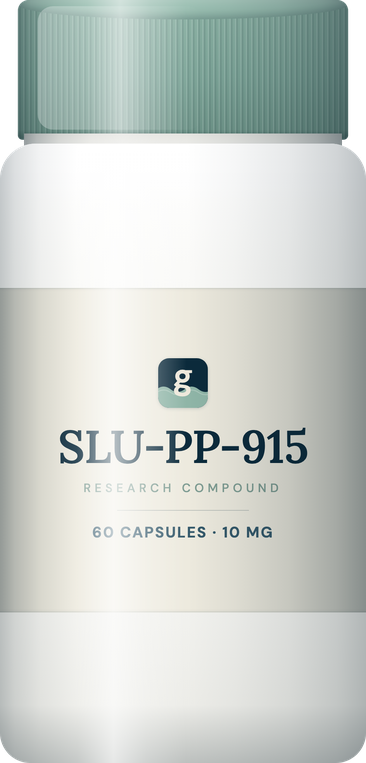
The app shows no recommended dose ladder for this compound because no human protocol exists. The product this entry is written against is an oral capsule — a 60-count bottle of 10 mg capsules, taken as 10 mg once daily.
That 10 mg figure comes from vendor labeling and rodent extrapolation; it does not appear in any trial, because no trial has ever been run.
What the arithmetic actually says: 10 mg/day in an 80 kg adult is 0.125 mg/kg/day. Reverse-scaled by the standard FDA body-surface-area method (mouse Km 3, human Km 37) that is about 1.5 mg/kg/day mouse-equivalent — below every published in vivo dose of this compound.
Scaling forward instead, the mouse regimens that were actually studied (20 mg/kg intraperitoneal, and 25 mg/kg twice daily for six weeks) translate to roughly 100 mg and 260 mg per day in an 80 kg adult, putting 10 mg somewhere near 10-fold to 25-fold below them. Two things break that comparison: those were efficacy doses, not no-adverse-effect doses, so the gap is not a safety margin; and all of them were injected intraperitoneally, a route surface-area scaling cannot convert into an oral human dose.
The real oral exposure difference is unquantified.
No research dose is presented for SLU-PP-915 — the goodtides app and Dose Calc present none either.
A research reference, not a prescription.
The estrogen-related receptors ERR-alpha, ERR-beta and ERR-gamma are orphan nuclear receptors: structurally close to the estrogen receptor, especially in the DNA-binding domain, but with no confirmed endogenous ligand. Rather than waiting to be switched on, they are constitutively active, and their output is set largely by coactivator proteins such as PGC-1alpha.
The limits are the important part.
What they transcribe is the machinery of aerobic metabolism — mitochondrial biogenesis, oxidative phosphorylation, fatty acid oxidation, the Krebs cycle. Mouse genetics ties them to endurance: ERR-alpha-null mice are hypoactive with reduced exercise tolerance, muscle-specific ERR-gamma overexpression raises exercise capacity, and ERR-gamma haploinsufficiency lowers it.
That is the whole basis for calling an ERR agonist an 'exercise mimetic' — a proposed label from preclinical work, not a demonstrated human effect. Worth noting for anyone reading 'orphan receptor' as 'insulated from hormones': ERR-alpha can occupy estrogen response elements, compete with ER-alpha for those sites and for the SRC-1a coactivator, and 4-hydroxytamoxifen binds and deactivates ERR-gamma.
The two systems are related, not separate.
SLU-PP-915 is a synthetic small molecule from the Walker and Burris laboratories: [3-[5-[(2-fluorophenyl)carbamoyl]thiophen-2-yl]phenyl]boronic acid, a 2,5-disubstituted thiophene carboxamide carrying a phenylboronic acid, C17H13BFNO3S, 341.2 g/mol. It appears as compound 10s in the 2023 European Journal of Medicinal Chemistry paper that introduced it.
The series was designed by structure-based drug design starting from the acyl hydrazide template that GSK-4716 and SLU-PP-332 exemplify, with the goal of moving off that scaffold; the boronic acid was added to improve metabolic stability. So SLU-PP-915 and SLU-PP-332 are genuinely different chemotypes with a shared design lineage and a shared target, not close analogs.
In cell-based co-transfection reporter assays SLU-PP-915 is a near-balanced pan-agonist: EC50 0.414 micromolar at ERR-alpha, 0.435 at ERR-beta, 0.378 at ERR-gamma, with maximal efficacy at ERR-gamma of 167% relative to SLU-PP-332. Direct binding to the ERR-gamma ligand-binding domain was confirmed by NMR, and it had no activity at estrogen receptor alpha or beta in those assays.
The comparison to SLU-PP-332 is worth stating precisely, because 'newer' does not mean 'stronger': SLU-PP-332 in the same assay set gave 0.098 micromolar at ERR-alpha, 0.23 at ERR-beta and 0.428 at ERR-gamma. SLU-PP-915 is roughly four-fold less potent at ERR-alpha and about two-fold less at ERR-beta; it is marginally more potent and clearly more efficacious at ERR-gamma.
Its real distinctions are a flat isoform profile rather than SLU-PP-332's ERR-alpha tilt, and better in vitro microsomal stability — a half-life exceeding 60 minutes in both mouse and human liver microsomes, though 60 minutes was the length of the assay, so that number is a ceiling and not a measured half-life. These are all two-run averages in transfected cells, reported without variance.
The defining property, and the reason the molecule exists, is route. The developing laboratory states plainly that SLU-PP-332 lacks oral bioavailability; every efficacy result for it was produced by intraperitoneal injection.
A 2026 paper in the Journal of Pharmacology and Experimental Therapeutics reports that SLU-PP-915 enhanced aerobic exercise performance in male C57BL/6 mice to a similar extent as SLU-PP-332 when injected, and maintained comparable efficacy when given orally, adjusted for systemic exposure. That qualifier matters: exposure-adjusted comparability is not an oral-versus-injectable dose equivalence, and no oral milligram-per-kilogram figure is stated in any accessible source.
Every SLU-PP-915 dose that can be verified in an open-access paper is intraperitoneal.
The in vivo record is small and it is entirely mouse. A single 20 mg/kg intraperitoneal dose raised Ddit4, Pdk4 and Pgc1a messenger RNA in quadriceps at one hour in a pilot cohort of three to four animals per group — an mRNA endpoint, no protein measured.
Six days of the same dose increased treadmill running time and distance in a run-to-exhaustion test, a result the paper reports directionally, without an effect size, and which does not appear in its own abstract. In a six-week pressure-overload heart failure model (transverse aortic constriction, 25 mg/kg intraperitoneally twice daily starting the day after surgery) SLU-PP-915 improved ejection fraction from two weeks onward, improved stroke volume and cardiac output at six weeks, reduced fibrosis and preserved mitochondrial respiration.
It did not reduce cardiac hypertrophy, and the reported survival benefit came from a curve pooling the SLU-PP-332 and SLU-PP-915 arms, so a survival effect for 915 alone is asserted rather than independently shown. Because dosing began before heart failure was established, that study tests prevention of decline, not reversal.
A single-dose mouse pharmacokinetic experiment exists but its plasma exposure appears only in a supplementary figure; no Cmax, Tmax, AUC, clearance or half-life is stated anywhere in the accessible text. There is no human data of any kind for SLU-PP-915 or for SLU-PP-332 — no trial registered on clinicaltrials.gov, no phase I, no human pharmacokinetics, no human safety.
No toxicology study of either compound has been published: no NOAEL, no genotoxicity, no carcinogenicity, no reproductive or developmental work. The only safety-adjacent statements in the literature are incidental remarks inside mouse efficacy papers — that no overt toxicity was seen at 25 mg/kg over six weeks, and that no overt adverse effects were noticed from either compound, with the authors adding that more detailed study is required.
That is an unblinded investigator impression in diseased animals, not a safety finding. The one time human material has met SLU-PP-915 is in a dish: liver microsomes and S9 fractions incubated with it to map metabolites for anti-doping detection.
The senior authors on this program disclose that SLU-PP-915 is covered by Saint Louis University intellectual property with one of them as inventor, and that he holds stock in two companies developing ERR agonists — context for reading the enthusiasm, not a reason to discount the chemistry.
- Half-life
- Not characterized in humans. The only figure published is in vitro: >60 min in both mouse and human liver microsomes at 0.1 micromolar — and 60 min was the length of the assay, so that is a ceiling, not a measured half-life.
- Peak
- No human data. Mouse plasma was sampled at 1, 2 and 4 hours after a single 20 mg/kg intraperitoneal dose, but the results appear only in a supplementary figure; no Cmax or Tmax is stated in any accessible text.
- Absorption
- Orally active in mice — the defining difference from SLU-PP-332, which its developers report lacks oral bioavailability. No human absorption data. Every verifiable published dose of SLU-PP-915 is intraperitoneal mouse dosing.
- Bioavailability
- Described by the developing laboratory as orally active in mice; oral dosing matched intraperitoneal efficacy 'adjusted for systemic exposure,' which is an exposure comparison and not a dose equivalence. No human bioavailability figure exists, and no oral mg/kg dose is stated in any accessible source.
References8
- Development and pharmacological evaluation of a new chemical series of potent pan-ERR agonists, identification of SLU-PP-915 (in vitro; mouse model)
- An orally active estrogen receptor-related receptor agonist, SLU-PP-915, enhances aerobic exercise capacity (mouse model)
- Novel Pan-ERR Agonists Ameliorate Heart Failure Through Enhancing Cardiac Fatty Acid Metabolism and Mitochondrial Function (mouse model)
- In Vitro Metabolism and Analytical Characterization of SLU-PP-332 and SLU-PP-915: Novel Pan-ERR Agonists With Doping Potential (in vitro)
- Synthetic ERRα/β/γ Agonist Induces an ERRα-Dependent Acute Aerobic Exercise Response and Enhances Exercise Capacity (mouse model)
- [Pharmacological Activation of ERRα/β/γ as an Exercise Mimetic: Potential Therapeutic Applications] (systematic review; preclinical evidence only)
- Dose translation from animal to human studies revisited (FASEB J; body-surface-area scaling method)
- PubChem - SLU-PP-915 Compound Summary, CID 142532359
Log every dose, count every vial, and verify your batches — free in the goodtides app.
This page is educational reference material about compounds studied in research settings. It is not medical advice, and nothing here is a recommendation to buy, possess, or use any compound. Research findings described are from published literature; individual compounds may not be approved for human use. Talk to a licensed clinician about anything that affects your health.