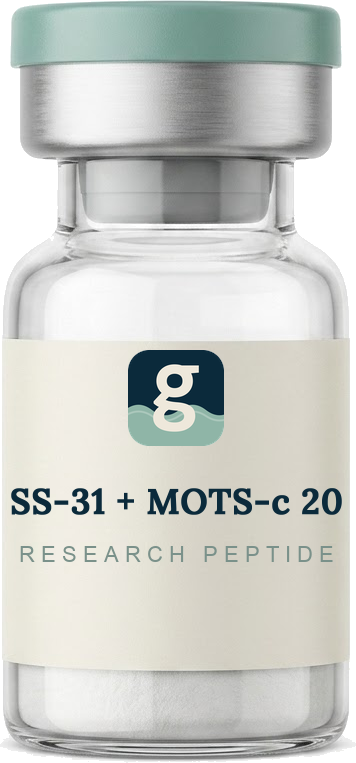
SS-31 + MOTS-c 20
SS-31 + MOTS-c 20 is a research-compound blend of SS-31 (elamipretide) and MOTS-c, 10 mg each in a 20 mg vial — MitoStack's 1:1 pairing at 0.4x its strength.
Mixed with 3 mL of bacteriostatic water it is dosed in insulin units: 15 units to start (0.5 mg of each), 45 units (1.5 mg) and 75 units at the top (2.5 mg of each), every other day, in 8-week-on / 4-week-off cycles.
Best for
Mitochondrial and metabolic research interest — the same pairing as MitoStack in a smaller vial. Unit numbers for the 50 mg MitoStack do not transfer: the same draw here carries 0.4x the mg.
What to expect
Elamipretide trial endpoints were measured over weeks to months; MOTS-c dosing data come from mice and rats. Human onset data for the blend do not exist.
Pairs with
Already pairs a membrane-targeting peptide with a mitochondrial-derived one; often discussed alongside NAD+. Do not run it beside MitoStack or a separate SS-31 or MOTS-c vial without counting both.
Subcutaneous injection every other day (2–3 times a week), morning or pre-workout. Reconstitute the 20 mg vial with 3 mL BAC water (3.33 mg/mL of each).
The ladder reads in mg per compound: 15 units = SS-31 0.5 · MOTS-c 0.5 mg (SS-31's own starting dose), 45 units = 1.5 mg of each, 75 units = 2.5 mg of each (0.75 mL in one injection). 8 weeks on, 4 weeks off. Specific dosing varies by goal and physician guidance.
- How often
- Every other day
- When
- Morning · Pre-workout
- Route
- Subcutaneous
- Vial & water
- 20 mg in 3 mL · 15 units ≈ 0.5 mg SS-31 + 0.5 mg MOTS-c
- Cycle
- 8 weeks on, 4 weeks off — both components are typically cycled rather than run continuously
The same numbers the goodtides app and the Dose Calc use — a research reference, not a prescription. Responses are individual; research protocols start at the low end.
SS-31 (elamipretide) is a four-amino-acid Szeto-Schiller peptide that concentrates in the inner mitochondrial membrane and binds cardiolipin, where research describes stabilized electron-transport-chain supercomplexes and reduced reactive-oxygen-species leak.
It has been given to people in trials at 40 mg a day (Barth syndrome, primary mitochondrial myopathy, heart failure); this ladder's 2.5 mg top, about three times a week, is far below that, and those trials do not validate this ladder.
MOTS-c is a 16-amino-acid peptide encoded in mitochondrial DNA that research links to AMPK activation and exercise-related metabolic regulation; it has no published human dosing by any route — its dosing studies are in mice and rats. No study of this combination exists, in people or animals, and neither compound is FDA-approved.
References6
- Reid Thompson W et al. A phase 2/3 randomized clinical trial followed by an open-label extension to evaluate the effectiveness of elamipretide in Barth syndrome, a genetic disorder of mitochondrial cardiolipin metabolism (Genet Med) (elamipretide 40 mg a day)
- Thompson WR et al. Long-term efficacy and safety of elamipretide in patients with Barth syndrome: 168-week open-label extension results of TAZPOWER (Genet Med) (40 mg a day under the skin)
- Karaa A et al. Efficacy and Safety of Elamipretide in Individuals With Primary Mitochondrial Myopathy: The MMPOWER-3 Randomized Clinical Trial (Neurology) (40 mg a day under the skin)
- Karaa A et al. A randomized crossover trial of elamipretide in adults with primary mitochondrial myopathy (J Cachexia Sarcopenia Muscle)
- Butler J et al. Effects of Elamipretide on Left Ventricular Function in Patients With Heart Failure With Reduced Ejection Fraction: The PROGRESS-HF Phase 2 Trial (J Card Fail) (4 or 40 mg a day)
- Reynolds JC et al. MOTS-c is an exercise-induced mitochondrial-encoded regulator of age-dependent physical decline and muscle homeostasis (Nat Commun) (MOTS-c dosing in mice)
Log every dose, count every vial, and verify your batches — free in the goodtides app.
This page is educational reference material about compounds studied in research settings. It is not medical advice, and nothing here is a recommendation to buy, possess, or use any compound. Research findings described are from published literature; individual compounds may not be approved for human use. Talk to a licensed clinician about anything that affects your health.