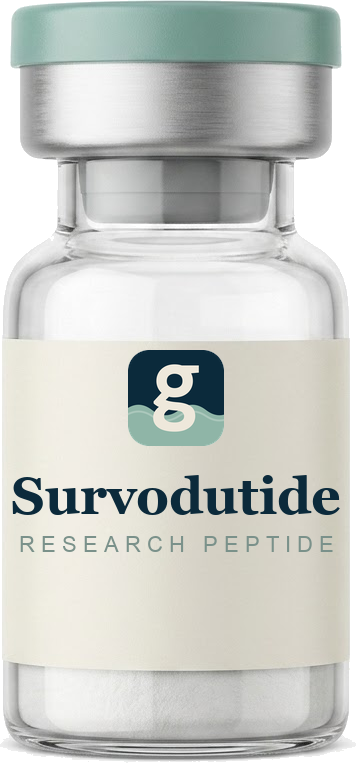
Survodutide
Survodutide (BI 456906) is a synthetic glucagon-derived peptide acting as a dual GLP-1 and glucagon receptor agonist, studied for weight management and MASH/liver disease; research protocols use once-weekly subcutaneous dosing that starts low (around 0.6 mg) and titrates gradually toward a 3.6 mg or 6.0 mg weekly maintenance target.
Best for
Survodutide has been studied primarily for chronic weight management in adults with overweight or obesity, and for metabolic dysfunction-associated steatohepatitis (MASH/NASH) with liver fibrosis; it has also been evaluated in type 2 diabetes contexts. Research use only — not an FDA-approved product.
What to expect
Research reports gradual effects: appetite changes are typically observed within the first weeks, with progressive body-weight reduction accumulating over many months across the multi-week titration; Phase 2 data reported roughly 12-15% mean weight loss over about 46 weeks at higher doses, and some trials had not reached a weight plateau by study end.
Pairs with
In research and trial contexts survodutide is generally used on its own as a foundational agent rather than stacked, studied alongside lifestyle and dietary interventions rather than combined with other incretin peptides. Stacking multiple GLP-class agonists is not supported by the research and compounds their GI and heart-rate effects.
Published trials (Phase 2 and the Phase 3 SYNCHRONIZE program) use a once-weekly subcutaneous injection with slow, stepwise dose escalation over several weeks — beginning at a low starting dose and titrating toward a weekly maintenance dose of 3.6 mg or 6.0 mg.
The slow ramp exists specifically to let the gut adapt and reduce nausea; do not skip steps.
Conservative research framing: start at the lowest step (~0.6 mg/week), hold each step for roughly 2-4 weeks, and only advance if well tolerated. Confirm any plan with a qualified physician.
- How often
- Weekly
- When
- Morning
- Route
- Subcutaneous
- Vial & water
- 10 mg vial in 2 mL = 5 mg/mL · 0.6 mg = 12 units on a U-100 syringe
- Cycle
- 0.6 mg (wk 1-2) → 1.2-2.4 mg (mid) → 3.6 mg or 6.0 mg maintenance. Slow monthly steps mirror the SYNCHRONIZE Phase 3 escalation and limit GI effects.
The same numbers the goodtides app and the Dose Calc use — a research reference, not a prescription. Responses are individual; research protocols start at the low end.
No approved brand anywhere. Survodutide has completed phase 3 but has never been reviewed, approved, or sold as a finished medicine.
Survodutide (research designation BI 456906) is a 29-amino-acid synthetic peptide derived from the glucagon backbone and engineered to co-activate two receptors: the glucagon-like peptide-1 receptor (GLP-1R) and the glucagon receptor (GCGR).
Developed by Boehringer Ingelheim and Zealand Pharma, survodutide is not FDA-approved and remains an investigational research compound; a research-use vial is not a branded pharmaceutical product and may vary in identity, purity, and content.
Structurally it carries a non-coded Ac4c residue at position 2 and a C18 fatty-diacid conjugation that binds circulating albumin, extending the half-life enough to support once-weekly subcutaneous dosing. Mechanistically, GLP-1R activation enhances glucose-dependent insulin secretion, suppresses glucagon-driven glucose output, slows gastric emptying, and reduces appetite via central pathways; GCGR activation is studied for increasing energy expenditure and influencing hepatic lipid metabolism, which is the rationale for its investigation in fatty liver disease (MASH).
This dual GCGR/GLP-1R pharmacology places it in the same broad class as mazdutide (oxyntomodulin analog) but distinct from GLP-1-only agents (semaglutide) and GLP-1/GIP agents (tirzepatide).
References4
- Boehringer Ingelheim — Survodutide (BI 456906) GLP-1/GCGR agonist pipeline
- le Roux CW et al. — Glucagon/GLP-1 dual agonist survodutide for obesity: Phase 2 dose-finding trial, Lancet
- SYNCHRONIZE-1 and -2 — Rationale and design of Phase 3 obesity trials, PMC
- Zorn et al. — BI 456906: discovery and preclinical pharmacology of a novel GCGR/GLP-1R dual agonist, PMC
Log every dose, count every vial, and verify your batches — free in the goodtides app.
This page is educational reference material about compounds studied in research settings. It is not medical advice, and nothing here is a recommendation to buy, possess, or use any compound. Research findings described are from published literature; individual compounds may not be approved for human use. Talk to a licensed clinician about anything that affects your health.