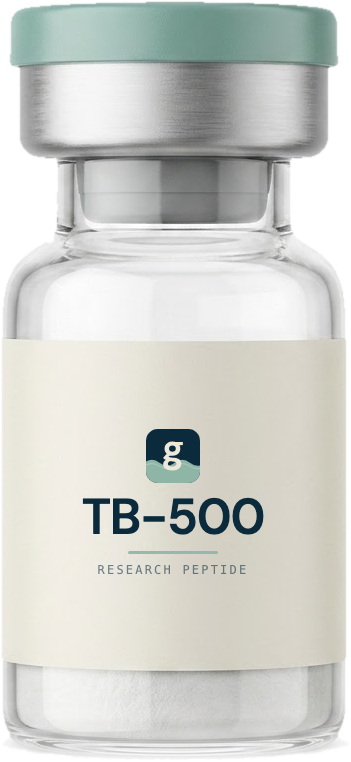
TB-500
TB-500 is a synthetic peptide related to thymosin beta-4, studied for soft-tissue and wound repair, cell migration, and angiogenesis; research protocols typically use about 1 mg twice weekly subcutaneously (range 0.5-5 mg).
Best for
It has been studied primarily in preclinical and laboratory settings for soft-tissue and wound repair, cell migration, angiogenesis, and reduction of inflammatory signaling.
What to expect
Time-to-effect is not well defined for TB-500 in humans; preclinical models report tissue-repair and migration effects over days to weeks of repeated administration.
Pairs with
It is commonly stacked in research and protocol contexts with BPC-157 for complementary soft-tissue recovery support.
In research contexts thymosin beta-4-related peptides are typically administered by subcutaneous injection, and the founder handbook describes an approximately 1 mg every-other-day approach, though no standardized human dosing for TB-500 has been established.
These figures are research-community reference points; no controlled human dose has been established.
- How often
- 2×/week
- Route
- Subcutaneous
- Vial & water
- 10 mg vial in 1 mL = 10 mg/mL · 1 mg = 10 units on a U-100 syringe
- Cycle
- 4–6 wk loading at 2–3×/wk, then 1×/wk maintenance
The same numbers the goodtides app and the Dose Calc use — a research reference, not a prescription. Responses are individual; research protocols start at the low end.
TB-500 is a synthetic peptide related to thymosin beta-4 (Tβ4), a naturally occurring 43-amino-acid actin-sequestering peptide that is among the most abundant members of the beta-thymosin family in mammalian tissue. TB-500 contains the actin-binding region (including the LKKTET motif of the WH2 domain) thought to carry much of Tβ4's cell-biological activity.
Neither TB-500 nor thymosin beta-4 is FDA-approved; full-length Tβ4 has been investigated in clinical trials (e.g., RegeneRx programs in ophthalmology and cardiac injury), while TB-500 itself is used as a research compound and is not approved for human use.
Research has characterized Tβ4 as the major monomeric (G-)actin-sequestering peptide in cells: it binds globular actin monomers and modulates the polymerization dynamics that govern cell shape and motility. Through these and related actions, preclinical and laboratory studies have explored roles in cell migration, angiogenesis, reduced inflammatory signaling, and soft-tissue and wound repair across dermal, corneal, and cardiac injury models.
- Half-life
- ~2-3 hours plasma
- Peak
- ~1-2 hr post-SC
- Absorption
- SC well-absorbed; systemic distribution
- Bioavailability
- SC ~80-90%
References4
- Goldstein AL et al. Thymosin beta4: actin-sequestering protein moonlights to repair injured tissues (Trends Mol Med)
- Bock-Marquette I et al. Thymosin beta4 activates integrin-linked kinase and promotes cardiac cell migration, survival and cardiac repair (Nature) (mouse model)
- Ruff D et al. A randomized, placebo-controlled, single and multiple dose study of intravenous thymosin beta4 in healthy volunteers (Ann N Y Acad Sci)
- A first-in-human, randomized, double-blind, single- and multiple-dose, phase I study of recombinant human thymosin beta-4 in healthy volunteers (J Cell Mol Med)
Log every dose, count every vial, and verify your batches — free in the goodtides app.
This page is educational reference material about compounds studied in research settings. It is not medical advice, and nothing here is a recommendation to buy, possess, or use any compound. Research findings described are from published literature; individual compounds may not be approved for human use. Talk to a licensed clinician about anything that affects your health.