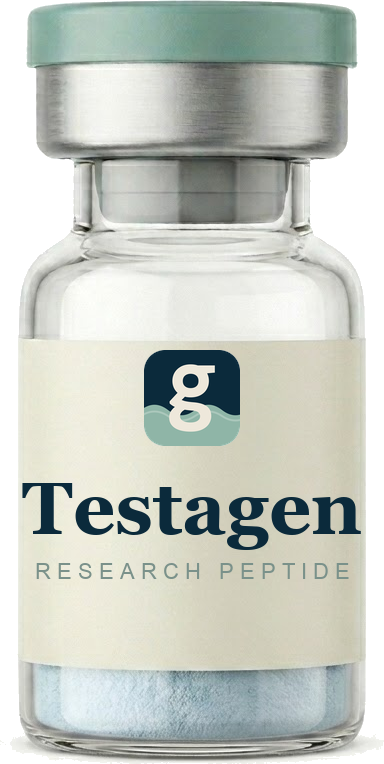
Testagen
Testagen is a synthetic tetrapeptide (Lys-Glu-Asp-Gly, abbreviated KEDG) from the Khavinson bioregulator program, derived from reproductive-tissue extracts; research protocols typically use 10 mg sublingually each morning in short 10-20 day courses. Despite the name it contains no steroid and is unrelated to testosterone, and no controlled human trial of it has been published.
Best for
Adults researching the Khavinson bioregulator class. It is not a hormone therapy and no published trial shows it changes testosterone or any reproductive endpoint in humans — anyone with an actual hormonal or fertility concern needs a clinician and lab work, not a research peptide.
What to expect
No human onset data exists. The cyclic course length comes from the bioregulator literature's dosing convention, not from any measured time-to-effect.
Pairs with
Discussed within the bioregulator literature alongside the other tissue-directed Khavinson peptides (Cardiogen, Vesugen, Livagen), conventionally as separate short courses rather than a stack. There is no evidence supporting any combination, and it should not be layered onto prescribed hormone therapy without a clinician's involvement.
Sublingual, once daily in the morning. The catalog reference is 10 mg per day, with a research range of 5-20 mg (5 mg as a conservative start, 20 mg at the high end), taken as cyclic 10-20 day courses rather than continuously. These are research references only, not a clinical regimen.
- How often
- Daily
- When
- Morning
- Route
- Sublingual
- Cycle
- Cyclic 10–20 day courses — not continuous.
The same numbers the goodtides app and the Dose Calc use — a research reference, not a prescription. Responses are individual; research protocols start at the low end.
Testagen is the tetrapeptide Lys-Glu-Asp-Gly, one of the defined short-peptide 'cytogens' Khavinson's group synthesized after fractionating tissue extracts — in this case testicular tissue — down to their shortest reportedly active sequences. The proposed mechanism is epigenetic rather than hormonal.
A 2011 study in Biochemistry (Moscow) used fluorescein-labelled peptides to show that Testagen, alongside epitalon and pinealon, enters the cytoplasm, nucleus, and nucleolus of HeLa cells, and that the unlabelled peptides quench the fluorescence of labelled deoxyribooligonucleotides to different degrees depending on their primary sequence — evidence the authors read as sequence-preferential binding to DNA, with Testagen showing preference for CAG-containing sequences. The proposition is that such binding could epigenetically influence gene activity in the tissue the peptide was derived from.
Later molecular-modelling work from the same group placed KEDG among 26 ultrashort peptides predicted to be transportable by the LAT and PEPT transporter families, the theoretical rationale for sublingual and oral dosing. What has to be said plainly is how little exists beyond that: PubMed indexes only two records mentioning Testagen at all — the 2011 nuclear-penetration study co-authored by the program's developer, and a 2025 materials-chemistry paper using the peptide as a copper corrosion inhibitor.
There is no controlled human trial, no toxicology study, no reproductive-safety study, and no pharmacokinetic data. The name is a tissue-of-origin label, not a claim of androgenic activity.
- Half-life
- Not established in humans. Peptides this short are expected to be cleaved rapidly by plasma and gut peptidases.
- Peak
- Not established — no human pharmacokinetic study published
- Absorption
- Sublingual or oral in the cited course protocols; shown in vitro to penetrate cells and nuclei, and predicted by docking work to be a LAT/PEPT transporter substrate, but with no measured human absorption data
- Bioavailability
- Not measured in humans
References3
- Penetration of short fluorescence-labeled peptides into the nucleus in HeLa cells and in vitro specific interaction of the peptides with deoxyribooligonucleotides and DNA
- Feasibility of Transport of 26 Biologically Active Ultrashort Peptides via LAT and PEPT Family Transporters
- Peptide bioregulation of aging: results and prospects
Log every dose, count every vial, and verify your batches — free in the goodtides app.
This page is educational reference material about compounds studied in research settings. It is not medical advice, and nothing here is a recommendation to buy, possess, or use any compound. Research findings described are from published literature; individual compounds may not be approved for human use. Talk to a licensed clinician about anything that affects your health.