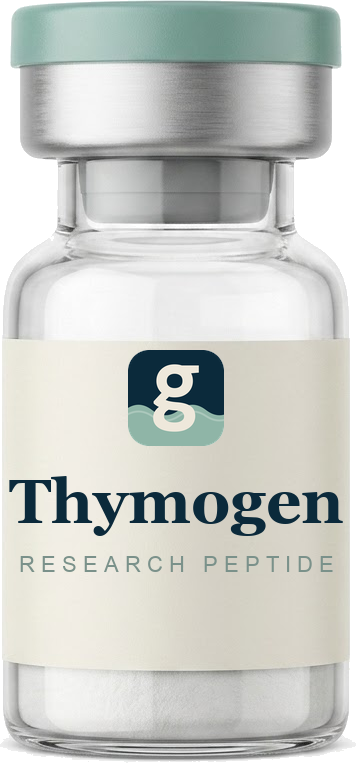
Thymogen
Thymogen is a synthetic thymic dipeptide (L-glutamyl-L-tryptophan, Glu-Trp) developed in Russia as an immunomodulator; research and Russian clinical protocols typically use 100 mcg subcutaneously or intramuscularly once daily in short 5-10 day courses (injectable range 100-1000 mcg). Note: it is dosed in MICROGRAMS — the 20 mg printed on the vial is the total lyophilized powder mass, not a single dose.
Best for
It has been studied primarily for immune modulation and restoration — secondary immunodeficiency states, recovery of immune function after infection or radiation, and as an adjunct in chronic bacterial and viral illness — as well as in aging/geroprotective research as part of the Khavinson short-peptide program.
What to expect
Immune endpoints in the underlying research are assessed over the days-to-weeks span of a dosing course and across repeated periodic courses rather than acutely; formal Western-standard pharmacokinetic data (plasma half-life, bioavailability) for the injectable form are not published.
Pairs with
In longevity and immune research it is discussed alongside other Khavinson bioregulators — notably the thymic extract Thymalin (immune) and the pineal peptide Epithalon/Epitalon (longevity) — and it is sometimes grouped with other thymic peptides such as Thymosin alpha-1.
Russian clinical protocols and research use short repeated courses rather than continuous dosing: injectable Thymogen at 100-1000 mcg (1-10 mL of a 100 mcg/mL solution) once daily for 3-10 consecutive days, repeated periodically. A registered intranasal spray delivers roughly 25 mcg per dose, one dose per nostril twice daily for 3-10 days.
A conservative research default is 100 mcg SC once daily in the morning for a ~10-day course. Reconstitution note: dissolving a 20 mg vial in 2 mL yields 10,000 mcg/mL, so 100 mcg is only 0.01 mL (1 unit on a 100-unit insulin syringe) — the large powder mass relative to the microgram dose means high dilution and very small draws.
- How often
- Daily
- When
- Morning
- Route
- Subcutaneous
- Vial & water
- 20 mg vial in 3 mL = 6.67 mg/mL · 100 mcg = 1.5 units on a U-100 syringe
- Cycle
- Short 5-10 day course, repeated periodically rather than dosed continuously (Russian clinical protocols use 3-10 day courses)
The same numbers the goodtides app and the Dose Calc use — a research reference, not a prescription. Responses are individual; research protocols start at the low end.
Thymogen is a synthetic dipeptide, L-glutamyl-L-tryptophan (Glu-Trp, molecular weight ~333 g/mol), identified as one of the shortest biologically active fragments derived from the thymic peptide bioregulator work of Vladimir Khavinson and colleagues at the Institute of Bioregulation and Gerontology in St. Petersburg.
It is registered as a pharmaceutical (injection and intranasal spray) in the Russian Federation but is not FDA-approved; outside Russia it is handled as a research compound, and much of the immunomodulatory and geroprotective evidence comes from a limited number of research groups and remains to be independently confirmed in large modern trials.
It is regarded in research as an immunomodulator: it has been studied for its proposed role in stimulating thymic epithelial production of thymulin (thymic serum factor), promoting T-lymphocyte differentiation and maturation (influencing CD3/CD4/CD8 populations), normalizing the Th1/Th2 cytokine balance, and supporting NK-cell activity. As a very short peptide it is thought to act at the level of gene expression and protein synthesis in immune cells.
References2
Log every dose, count every vial, and verify your batches — free in the goodtides app.
This page is educational reference material about compounds studied in research settings. It is not medical advice, and nothing here is a recommendation to buy, possess, or use any compound. Research findings described are from published literature; individual compounds may not be approved for human use. Talk to a licensed clinician about anything that affects your health.