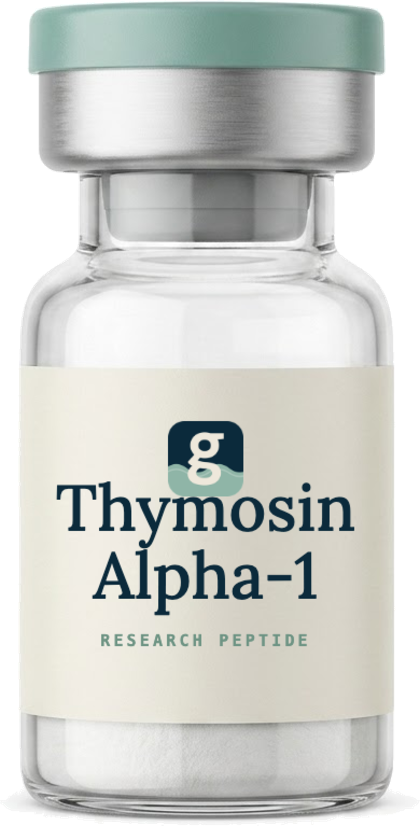
Thymosin Alpha-1
Thymosin Alpha-1 (marketed as Zadaxin / thymalfasin) is a synthetic 28-amino-acid immune-modulating peptide derived from the thymus hormone prothymosin alpha. It is studied primarily for its ability to enhance T-cell and natural killer cell function and support antiviral immune responses, and is approved in some countries as an adjunct in chronic hepatitis B and C and certain vaccine settings.
Best for
Individuals researching immune modulation, T-cell function, or antiviral/immune-support contexts under medical supervision.
What to expect
Immunological effects (dendritic cell and T-cell activation) begin within days, but measurable immune shifts in research typically emerge over several weeks of consistent dosing.
Pairs with
Typically run standalone; in some research it has been combined with interferon or vaccines under clinical supervision.
The most commonly documented research protocol is 1.6 mg subcutaneously twice weekly; some studies use up to 3.2 mg twice weekly. Courses typically run several weeks to a few months. 1.6 mg is the conservative documented starting dose.
- How often
- 2×/week
- When
- Morning
- Route
- Subcutaneous
- Vial & water
- 5 mg vial in 1 mL = 5 mg/mL · 1.6 mg = 32 units on a U-100 syringe
- Cycle
- Research protocols typically run in defined courses of several weeks to a few months rather than indefinitely; cycling length is individualized under physician guidance.
The same numbers the goodtides app and the Dose Calc use — a research reference, not a prescription. Responses are individual; research protocols start at the low end.
Thymosin Alpha-1 is a naturally occurring peptide fragment cleaved from prothymosin alpha and originally isolated from thymic tissue, the organ central to T-cell maturation. The synthetic 28-amino-acid version (thymalfasin) is a faithful copy of the endogenous sequence.
In the U.S. it is not FDA-approved and is considered a research compound.
Its principal mechanism appears to be signaling through Toll-like receptors, notably TLR9 and TLR2, on dendritic cells and macrophages, which promotes maturation of these antigen-presenting cells and biases the immune response toward a Th1, cell-mediated profile. Downstream effects reported in research include enhanced differentiation and proliferation of T-cells, increased natural killer cell activity, and modulation of pro- and anti-inflammatory cytokines, which is why it is described as an immune modulator rather than a simple stimulant.
Clinical research has examined it chiefly as an adjunct in chronic viral hepatitis, certain cancers, and as a vaccine enhancer, and it holds regulatory approval for some of these uses in a number of countries outside the United States. Evidence quality varies by indication, and much of the immune-boosting framing outside of approved settings rests on limited or preliminary data.
This information is provided for research and educational context only, is not medical advice, and use should occur under qualified physician guidance.
References3
- Chien RN et al. - Efficacy of thymosin alpha1 in patients with chronic hepatitis B: a randomized, controlled trial (Hepatology)
- Zhang YY et al. - Lamivudine versus lamivudine plus thymosin alpha-1 for HBeAg-positive chronic hepatitis B: a meta-analysis (Virol J)
- Camerini R, Garaci E - Historical review of thymosin alpha-1 in infectious diseases (Expert Opin Biol Ther; thymalfasin is not FDA-approved in the US)
Log every dose, count every vial, and verify your batches — free in the goodtides app.
This page is educational reference material about compounds studied in research settings. It is not medical advice, and nothing here is a recommendation to buy, possess, or use any compound. Research findings described are from published literature; individual compounds may not be approved for human use. Talk to a licensed clinician about anything that affects your health.