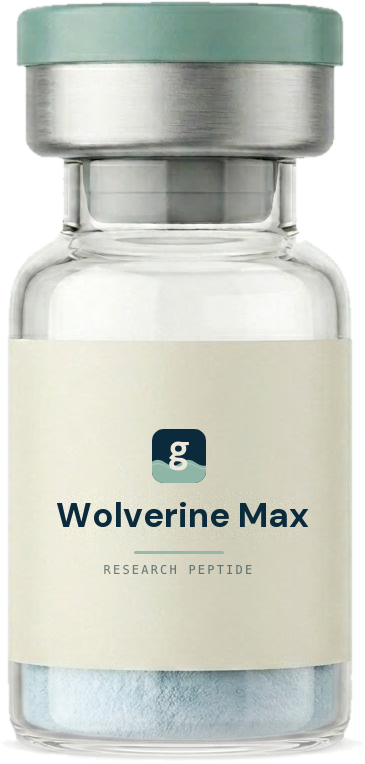
Wolverine Max
Wolverine Max is a research-compound blend of Cartalax (24 mg) with BPC-157, TB-500 and KPV (12 mg each) — 60 mg in a 3 mL vial, extending Wolverine+ with a cartilage-focused bioregulator. Research protocols dose it once daily by subcutaneous injection in insulin units: about 8 units for maintenance, 17 for recovery and 25 for healing.
Best for
Recovery-focused research where the BPC-157 + TB-500 + KPV pairing of Wolverine+ is extended toward joint and connective tissue with Cartalax, a Khavinson short peptide studied in cell and animal work on cartilage. Four active compounds in one vial is not a first-time protocol, and physician guidance is advised.
What to expect
Component research and anecdotal reports describe soft-tissue effects over roughly one to several weeks; Cartalax, as a proposed gene-expression bioregulator, is described as acting gradually over a course rather than acutely. Rigorous human onset data for the blend do not exist.
Pairs with
Built as a broad standalone recovery stack — running it alongside separate BPC-157, TB-500, KPV or Cartalax vials, or alongside Wolverine, Wolverine+ or KLOW, doubles up the same compounds. Sometimes discussed alongside growth-hormone secretagogues such as CJC-1295 + Ipamorelin in recovery stacks.
Subcutaneous injection once daily, dosed by insulin units — not mg of each, because the split is 2:1:1:1 (Cartalax 24 mg + 12 mg each of BPC-157, TB-500 and KPV).
Unit or mg-each numbers for Wolverine or Wolverine+ do not transfer.
Reconstituted with 3 mL of bacteriostatic water the vial is 20 mg/mL, and the ladder reads in mg per component: 8 units for maintenance (about 0.64 mg Cartalax and 0.32 mg each of BPC-157, TB-500 and KPV), 17 units for recovery (1.36 / 0.68 / 0.68 / 0.68 mg) and 25 units for healing (2 mg Cartalax and 1 mg each of the other three — the point where KPV reaches its 1 mg daily research ceiling). Run in 6–8 week recovery blocks, then a break.
- How often
- Daily
- Route
- Subcutaneous
- Vial & water
- 60 mg in 3 mL · 8 units ≈ 0.64 mg Cartalax + 0.32 mg BPC-157 + 0.32 mg TB-500 + 0.32 mg KPV
- Cycle
- Run in 6–8 week recovery blocks, then a break.
The same numbers the goodtides app and the Dose Calc use — a research reference, not a prescription. Responses are individual; research protocols start at the low end.
Wolverine Max adds a fourth compound to the three of Wolverine+. BPC-157 is a stable 15-amino-acid gastric-derived peptide characterized preclinically by growth-hormone-receptor upregulation in tendon fibroblasts, nitric-oxide-system interaction and VEGF-linked angiogenesis at the injury site.
TB-500 is a synthetic fragment of thymosin beta-4 that sequesters G-actin to support cell migration and new blood-vessel formation. KPV is the C-terminal tripeptide of alpha-melanocyte-stimulating hormone, studied in animal and cell models for NF-κB-linked anti-inflammatory signaling in the gut and skin.
Cartalax is a Khavinson short-peptide bioregulator designated for cartilage and connective tissue; Russian preclinical and cell-culture work reports effects on chondrocyte gene expression and extracellular-matrix components, with limited independent replication. Cartalax is the largest component here at 24 mg, twice each of the other three.
No study of the four-way combination exists; none of the components is FDA-approved, the blend is handled as a research compound, and most evidence comes from animal and in-vitro work.
References4
- The promoting effect of pentadecapeptide BPC 157 on tendon healing involves tendon outgrowth, cell survival, and cell migration (rat model)
- Thymosin beta4 activates integrin-linked kinase and promotes cardiac cell migration, survival and cardiac repair (mouse model)
- PepT1-mediated tripeptide KPV uptake reduces intestinal inflammation (mouse model)
- Myakisheva SN et al. (Khavinson group) - Peptides prevent the forming of secretory phenotype of chondrocytes associated with the aging: AED peptide vs cartilage polypeptide complex (Adv Gerontol) (in vitro, human chondrocytes)
Log every dose, count every vial, and verify your batches — free in the goodtides app.
This page is educational reference material about compounds studied in research settings. It is not medical advice, and nothing here is a recommendation to buy, possess, or use any compound. Research findings described are from published literature; individual compounds may not be approved for human use. Talk to a licensed clinician about anything that affects your health.